
Digitizing Staff Training Assessments and Cutting the Time to Certification
Published on
 Employee Training (Training Management)
Published on

Training and Education Department

- Staff training assessments were conducted on paper, making grading time-consuming and prone to human error and inconsistencies.
- Securing venues across Japan and dispatching staff to regional locations as exam proctors created a significant operational and financial burden.
- Given the large volume of candidates and demanding exam standards, many participants struggled to reach the passing threshold.
- The organization lacked a dedicated mechanism to enable staff to study and practice independently on a repeated basis.


- learningBOX was introduced for training assessments at company-operated schools, automating the grading process to reduce workload and eliminate errors.
- Transitioning assessments online eliminated the need to secure physical venues or arrange travel, allowing candidates to retake exams seamlessly as needed.
- Establishing a system for continuous, self-directed study successfully reduced the average time to passing from 8 months to just 2.1 months.
- Thoroughly reviewing incorrect answers against the company manual became a routine practice, significantly boosting knowledge retention.
The company previously conducted paper-based training assessments for staff at its company-operated schools, which generated challenges regarding grading time, scoring errors, inconsistent marking standards, venue costs, and the logistical burden of regional travel. To resolve these issues, learningBOX was introduced to overhaul the written testing process; by enabling repeated, flexible learning, the platform helped reduce the average time to passing from 8 months to 2.1 months. Furthermore, embedding a routine where staff review incorrect answers against the manual has significantly enhanced overall knowledge retention. In this interview, we discussed the background of the implementation, the key outcomes achieved, and the company's future roadmap.


Rethinking a Written Exam Process That Placed Heavy Demands on People and Resources
Could you start by telling us about your business?
We operate individual tutoring schools, English conversation schools, early childhood education facilities, and privately run childcare nurseries. We also scale these business models through comprehensive franchise operations.
What led you to introduce learningBOX?
When we first adopted learningBOX about three years ago, our licensing system operated quite differently than it does today. We were managing two distinct types of assessments: a written exam to test theoretical knowledge and a separate practical exam, with the written component being conducted entirely on paper.
Grading was highly time-consuming, and human errors inevitably crept into the process. To maintain consistent marking standards, we had to limit the number of papers a single person could grade in one session to one or two, which meant the administrative workload consistently fell on specific team members and created a severe bottleneck.
Training assessments were held monthly, but due to a large candidate pool and rigorous passing criteria, many participants failed to reach the required standard. While passing individual modules was achievable, navigating through every single component in its entirety took a considerable amount of time.
Running these assessments required physical venues, prompting us to book community halls and similar facilities to conduct them at scale. However, finding venues that could accommodate both the written and practical components simultaneously was far from straightforward.
Our candidates were spread across the country, spanning Tokyo, Kyushu, the Kansai region, Tohoku, and beyond, covering all of our company-operated schools nationwide. Whenever we had a high concentration of candidates in a specific region like Kansai, we had to schedule multiple dates and dispatch staff in person to proctor the exams.
Every single time, our standard routine involved loading two massive wheeled suitcases into a taxi and heading to the venue, which created a substantial human and logistical burden. It was this operational reality that ultimately drove our desire to streamline how the written exam was managed.

Were there any other challenges beyond those?
Among the participants who did not pass, quite a few simply moved on after the exam without engaging in any meaningful review. The service we provide to children is built on the core principle of never leaving things half-done, of returning to material repeatedly until it is truly mastered. We felt it was essential to apply that same discipline to our own staff, making the need for a system that enabled independent, repeated practice glaringly clear.
With that context as our backdrop, we began exploring e-learning platforms for the training assessments at our company-operated schools. Having never operated in this digital space before, and given the education sector's general caution regarding technology investment, the barriers to adoption were not insignificant. Cost, in particular, was a primary consideration for us.
It was during this search that we discovered learningBOX—a platform available at an exceptionally accessible price point that also allowed us to create content and deliver video training entirely in-house. We felt that this cost-effective pricing made it well worth exploring as a trial, and we promptly moved forward with our evaluation.
Prioritizing the Ability to Create Training Materials Easily In-House
What criteria did you use in your search?
The search process took a considerable amount of time. E-learning traditionally carried a reputation for being difficult and costly to revise once materials were built, which was a genuine concern for our team. Beyond pricing, our key search criterion was the ability to develop and update content ourselves, quickly and without technical friction.
What was behind the emphasis on developing content in-house?
Our core thinking was that if we could create materials internally, we would ultimately be able to produce a wider variety of content at a much faster pace. We also believed that training videos did not need to be highly polished, as long as they were functionally effective. Additionally, since the design of the practice questions was something we would have to map out ourselves anyway, outsourcing the build to an external vendor felt like it would simply double our overall workload.

How was your experience with learningBOX?
Once the platform was up and running, I personally found it incredibly easy to create content. The real challenge lay in convincing the rest of the team that the platform was not nearly as complicated as they feared. Today, we seamlessly upload existing questions in a plain text format, while any new questions are built directly using the intuitive question form. The final output looks highly professional, the process remains simple, and anyone on the team can generate questions without difficulty.
Plans to Expand learningBOX Across Franchise Schools
What results have you seen since introducing learningBOX?
The ability to retake the exam multiple times has been genuinely well-received by our participants. The ultimate purpose of our training assessments is not to catch people out, but rather to help staff achieve a deep understanding and retain that knowledge efficiently. learningBOX allows them to build that competence through their own accumulated effort, which is an outcome we value highly.
The time required for participants to reach the passing standard has also shortened dramatically. Before we implemented learningBOX, the average timeline was around eight months. That figure has now plummeted to just 2.1 months.
That is a remarkable reduction. Would you say it reflects a higher level of motivation to learn?
That is certainly a contributing factor, but I believe the primary driver is that we now have an operational structure that genuinely facilitates repeated practice. With learningBOX, a staff member who decides to tackle just one module a day can typically spend five to ten minutes working through the questions first. If they answer incorrectly, they immediately consult the physical manual in the classroom, review that specific section, and deepen their understanding. After that targeted review, they can instantly try again. Being able to fit meaningful study into small pockets of spare time has made a profound difference.
How has e-learning affected knowledge retention?
Knowledge retention has improved significantly compared to our previous methods. Introducing e-learning has also made our existing physical manuals drastically more useful. Specifically, staff members are now far more likely to proactively revisit the manual to verify the specific areas they missed during a test.
A manual that simply sits on a shelf never takes root in daily practice. Our company's founder, Mr. Takahashi, frequently highlights this by saying: "Out of 100 attempts, only about 10 will go perfectly. But it is those 10 successes that get distilled into our operational know-how and manuals." For that reason, we explicitly ask our staff to take the manuals seriously and place total trust in their content.
You seem to place a great deal of emphasis on developing people from within.
We absolutely do. Our corporate philosophy centers on the aspiration to "discover the jewel inside every person, everywhere in the world," and to "give our all to making that jewel shine." However, because every individual grows at their own pace and brings a unique set of abilities, those developmental journeys naturally vary from person to person. We demand the exact same approach from our staff and school principals as we do toward our students to identify what is unique and positive in each individual and help it flourish.
At the same time, there is a fundamental baseline of proficiency that staff must achieve to deliver our core service. Our educational approach is guided by a firm belief in "educating individuals through individual attention," and we are fully committed to preserving that philosophy even as we introduce e-learning.
The core of what matters is not the grading or the progress summaries themselves, as those administrative tasks account for perhaps ten percent of the overall picture. What truly matters is observing those performance outcomes and behavioral changes, then responding thoughtfully to each person's specific situation and realities on the ground. That foundational truth holds firm whether we are working with children or adults.
Creating an environment where people can develop rapidly, while engaging with each individual with genuine care and attention, represents what real development and true "personalized instruction" mean to us. Introducing e-learning has enabled us to deliver that exact brand of individualized support in an even more refined manner, which is something we feel tangibly every day.
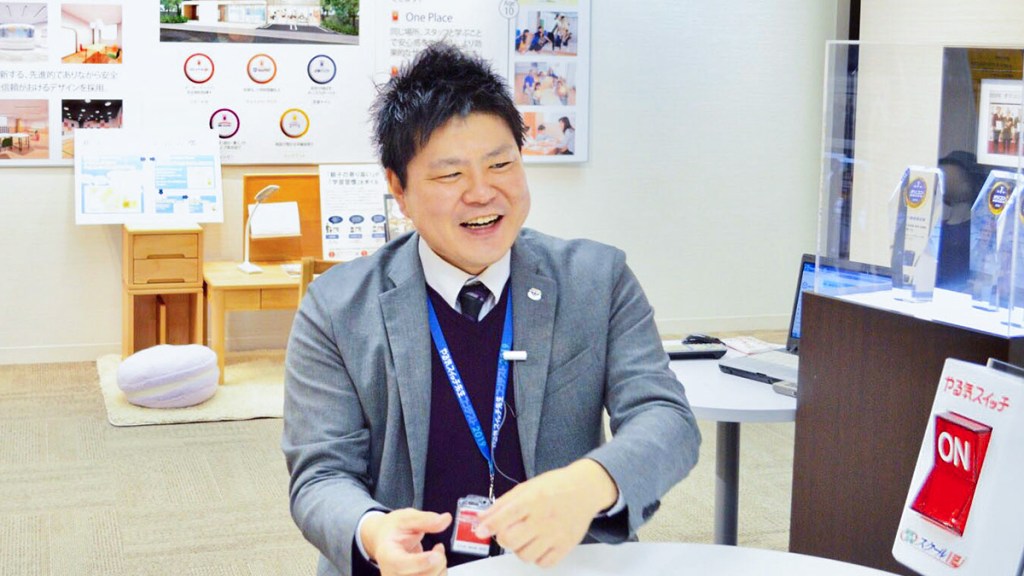
How do you plan to use learningBOX going forward?
At present, we utilize the platform solely for training assessments for staff at our company-operated schools. However, if only our company-operated locations grow stronger without all schools nationwide developing alongside them, we cannot genuinely deliver a consistently high-quality education. And in reality, our franchise locations far outnumber our company-operated schools.
The idea of extending this digital training assessment framework to our franchise schools has been on our radar for quite some time. The primary concern, however, was that participation rates might drop even further under traditional methods. Many franchise schools are located at a significant distance, and the steep cost of travel makes it genuinely difficult for owners to commit to attending in-person sessions. Equally, it would be logistically impractical for head office staff to visit every single school.
That geographical gap is exactly where we see learningBOX playing a pivotal role. First and foremost, we want franchise staff to pass the assessments and reach a clearly defined standard of competency. As one strategic approach to getting them there, we are looking into incorporating short, targeted instructional video content. People absorb information at different speeds; some can pass purely by reading the text materials, while others find that format insufficient. In those cases, the plan is to use instructional videos to bridge the comprehension gap before steering them back to the text for reinforcement. By offering multiple, flexible pathways to passing, we believe we can scale the training assessment framework to franchise schools in a way that actually drives engagement.
The success of learningBOX at our company-operated schools has gained widespread recognition internally, and the rollout to franchise schools is now actively progressing. While I have focused primarily on the School IE brand here—our fully customized individual tutoring schools—each of our other brands similarly possesses its own distinct set of manuals. The challenge we currently face is that those manuals are not being utilized to their full potential. Going forward, we plan to replicate the successful model established with School IE and introduce learningBOX across our other brands as well. If we adopt this approach company-wide, we will also need to transition to a dedicated server and establish an appropriate internal support and maintenance structure.
Finally, do you have a message for others who might be considering making this kind of change?
Many professionals working in education harbor a strong aversion to technology, and that conservative tendency seems far more pronounced in this industry than in most others. Yet, the children we serve today are growing up in an environment where technology is simply an integrated part of everyday life.
We occasionally hear from new students who tell us, "I've never attended a physical tutoring school before, but I have studied extensively using a tablet." Failing to adapt to that generational reality is no longer a viable position for educational institutions. We believe it is absolutely essential to genuinely understand the digital world our students inhabit, and to approach the shifts in that world not with reluctance, but with an open and forward-looking mindset.
Thank you very much for
sharing your valuable insights with us!