Eliminating Knowledge Silos and Transforming Mindsets: Sugiko's Journey in Education DX
 Employee Training (Training Management)
- Knowledge Sharing

Sugiko Co., Ltd. provides rental services for temporary construction equipment, technical support, and safety consulting, supporting safety and efficiency across the construction industry. The company had long relied heavily on on-the-job training (OJT) in the field for employee development, which led to challenges such as knowledge becoming siloed with specific individuals and inconsistencies in skill levels. By introducing learningBOX, Sugiko set out to standardize and streamline its training framework. As a result, the company not only reduced the time and effort required to create training materials and grade tests, but also saw a marked increase in employees' motivation to learn — generating positive change across the organization as a whole. In this interview, we spoke with Mr. Yajima about the background to the introduction, how the platform is being used in practice, and the company's vision going forward.
2. Technical support and safety consulting
Deputy Manager
Sales Training Division
- Training relied heavily on on-site OJT, leading to siloed knowledge and uneven skill levels
- Standardized training materials were not shared across the company, requiring each department to recreate materials from scratch every time
- A consistent training framework that could withstand changes in the social environment was needed
- Test creation, grading, and aggregation were handled manually, making management and analysis time-consuming
- An online learning environment makes the effectiveness of training visible and enabling structured, standardized training programs
- Employees can instantly access accurate, centrally managed knowledge, which is also utilized as a knowledge base
- Administrative tasks have been streamlined, and individual employees' skill and knowledge acquisition can now be tracked with greater visibility
- Awareness of education has grown across the entire organization, and cross-departmental collaboration has become smoother
- Ability to start small with a cost-effective structure that remains sustainable even for company-wide rollout
- A rich variety of question formats in the quiz and test function that supports deeper and more effective learning
- Administrators without specialized IT knowledge can easily create and update content
- Existing materials can be imported directly as training content, enabling a smooth start to operations


Overreliance on OJT and Knowledge Silos
In terms of your business, what kinds of knowledge do employees need for training purposes?
Our core business is the rental of temporary construction equipment, but simply having product knowledge is not enough. Because our customers operate primarily in the construction industry, a solid foundation of general construction sector knowledge is also essential. This requires a broad range of skills and expertise, including an understanding of how construction projects progress alongside a firm grasp of industry contracting practices.
At the same time, many of our mid-career hires come from entirely different industries—in fact, I myself previously worked in a completely unrelated field. As a result, I deeply appreciate how challenging it is to build this specialized knowledge base from scratch.
What challenges were you facing before introducing learningBOX?
We had been working to update our employee training programs, starting with new hire onboarding, and were developing curricula to build foundational knowledge and skills. At the time, a large portion of our training relied on on-the-job training (OJT) in the field, making knowledge siloing and inconsistent training quality significant issues.
The biggest hurdle, however, was the redundant effort involved in creating training materials. Because the required knowledge varies from client to client across our offices, there were no shared company-wide resources. Every time a new employee joined, the person responsible in each department had to start from scratch to recreate materials. It was not uncommon for that repetitive process to take two to three hours each time.
When I took on responsibility for new hire training myself, I found that the existing materials were outdated and no longer aligned with current field conditions, leaving me no choice but to rewrite them entirely.
What brought the need to overhaul your training approach to a head?
For internal group sessions, tests were being conducted on paper and graded manually, meaning administrative and analytical tasks were consuming a massive amount of time.
On top of that, while we were working to address the issue of localized knowledge and restructure our curriculum accordingly, sudden shifts in the social environment made it difficult to hold in-person training.
As a result, we faced an urgent and pressing need for a system that could deliver consistent, quality training regardless of location.
A Compelling Combination of Quiz/Test Features and Value for Money
How did you first come across learningBOX, and what initially caught your attention?
We discovered the platform through an internet search. What first stood out was its outstanding cost-effectiveness. At a stage when we were completely rebuilding our training framework, the price point—which made it easy to start small—was extremely appealing.
Up until then, we had been relying on Excel, Word, and paper to create and grade tests, and we were actively looking for ways to streamline those processes. learningBOX offered exactly what we needed, backed by robust learning management functionality.
The variety of available question formats means that participants do not simply guess answers—they engage with the material thoughtfully, which we felt would lead to much deeper learning outcomes.

Were there any specific aspects of learningBOX that you evaluated particularly highly at the consideration stage?
There were two specific advantages that stood out. The first was its exceptional flexibility for building proprietary, in-house training content. The scaffolding and temporary construction equipment industry we operate in is a highly niche field, meaning off-the-shelf training materials are simply insufficient for covering the practical knowledge required.
With learningBOX, the platform is designed so that administrators—even those without specialized IT skills—can easily create and update tests and slides incorporating highly specialized content. That flexibility to readily build a dedicated, company-specific training platform was a perfect fit for our needs.
The second key factor was its sustainable cost structure. Not only were the initial setup costs low, but the running costs were also highly manageable when we considered a potential company-wide rollout in the future. When thinking long-term about delivering equal training opportunities to every employee, that strong cost-effectiveness was a major factor in our decision-making from a management perspective.
What ultimately sealed the decision to move forward?
As I mentioned, the ability to satisfy both conditions simultaneously—developing proprietary training content in-house while maintaining a sustainable cost structure—was the ultimate deciding factor.
On top of that, the ability to import existing internal content like PowerPoint presentations and PDFs directly into the system was a massive advantage. Knowing that we could get up and running smoothly without having to rebuild our materials from scratch was another compelling reason we chose learningBOX.
Leveraging Existing Materials to Dramatically Reduce Content Preparation Time
Please describe the process from implementation to the launch of operations.
The management decision to proceed was made very quickly. We started small with 300 accounts, which meant the approval process required minimal preparation, and we were up and running in no time.
Additionally, the decision to set up individual folders that each office could use freely and to divide costs on a per-office basis made the rollout go even more smoothly.
When it came to getting started, rather than recreating all of our materials from the ground up, we were able to upload existing PowerPoint presentations and PDFs directly, which dramatically reduced the time and effort required for content preparation.
How is your content creation process organized?
Our general approach is to delegate content creation to each department. The training division makes its own materials openly accessible, and in some cases, individual field teams use that content as a base and adapt it for use in their own OJT.
Currently, we are creating more than ten new content items per year, and we are also putting increasing focus on the development of video content.
Highly Intuitive for All Users, Regardless of IT Experience
How have you found the platform as an administrator?
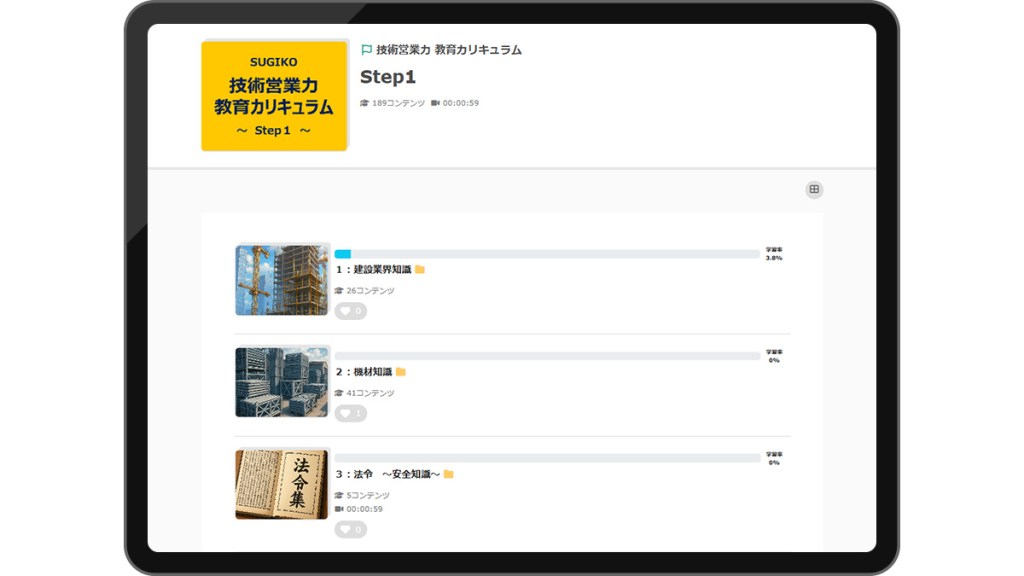
Both sales staff and administrative staff — regardless of their IT experience — have been able to use it smoothly without any issues, and we find it very intuitive.
The UI is simple and clear, with a logical flow that allows administrators to navigate the system confidently, so once you understand the overall structure, operating it is straightforward. The ability to configure granular Management roles is also very convenient, making it easy to tailor management practices to each department's needs.
Features such as Prerequisites and Disable skip playback help ensure that learners progress through training systematically, and we appreciate having a well-structured environment to support reliable knowledge acquisition. The flexibility to build the optimal learning environment ourselves to address specific challenges has also been a major advantage.
How have learners responded?
New employees have responded very positively, telling us they appreciate being able to learn at their own pace, anywhere, and during their free time. Sales staff in particular use learningBOX as a knowledge base, since the specialist knowledge required varies from client to client.
Previously, employees often had to ask colleagues when they were unsure where to look or when materials were unavailable, and responses would vary depending on who was asked. Now, staff can instantly access accurate, centrally managed information, which has also contributed to improved operational efficiency.
Consistently Responsive and Thorough Post-Implementation Support
How would you assess learningBOX's support?
We are very satisfied with the support as well. Whenever we have a question and reach out, the team provides thorough and thoughtful responses — even when the information is available on the website, they take the time to elaborate and ensure we come away with a deeper understanding.
What we found particularly helpful was when our internal system administrator changed. The support team took the time to walk the new administrator through the platform's features and best practices for management step by step, which made the handover very smooth.
As we have continued to use the system, this level of dedicated support has given us a great deal of confidence.
Broad Use Cases from New Hire Onboarding to Specialist Training
In what specific training programs and contexts are you currently using learningBOX?
We now use it across a wide range of applications, not just for new hire onboarding, but also for mid-career hire training and the acquisition of specialist knowledge. The new hire training program for sales staff, in particular, runs from April through December, and employees continue to use learningBOX after joining their teams to reinforce what they have learned.
In addition, we have packaged each training program into a consistent workflow — uploading materials, conducting comprehension tests, and gathering feedback through surveys — and are rolling this out consistently. This structured approach has made it straightforward to measure the effectiveness of each training session.
Visibility into Training and a Shift in Organizational Mindset
What kinds of outcomes and changes have you observed since implementation?
The most significant achievement is that information has become far more accessible, and we now have an environment where employees can learn online regardless of their location or the time of day. Previously, our training infrastructure was far from adequate, and we had no choice but to rely on OJT. However, since introducing learningBOX, a mindset has emerged in which employees proactively pursue online learning while also incorporating planned OJT.
Since implementation, everyone has been able to access accurate knowledge quickly, which has shortened the time it takes for individuals to resolve questions on their own, and a regular cycle of review has been established. This has made it possible to develop skills consistently across the organization without depending on any one individual's experience, and has contributed to improved performance across the board.
In addition, the ability to visualize data on individual employees' skill and knowledge acquisition — something that was previously difficult to quantify — has been a major shift for the organization as a whole. We feel that awareness of training and development has grown significantly throughout the company.

Has it had any impact on cross-departmental collaboration?
After learning about how learningBOX was being used in the sales division, a separate division responsible for equipment management independently began developing its own curriculum last year.
Up until then, the training division had been the primary driver of content management, but we have since given each department its own permissions, creating a structure where teams can freely create and use content that reflects the unique characteristics of their work. This new approach has made it easier to advance OJT and skills development on the ground.
As a result, knowledge sharing between the equipment and sales divisions has also become much smoother.
Building a Hybrid Training Model
Please share your outlook for the future.
Going forward, we plan to strengthen a hybrid training model that combines in-person sessions with e-learning. The plan is to use learningBOX for efficient knowledge acquisition, while reserving in-person sessions for practice-oriented activities that are most effective in a face-to-face setting, such as role-playing and case studies.
We also intend to develop a broader range of training programs tailored to different job roles and career stages, and to build an environment where employees can learn proactively and progress through their studies at their own pace based on their individual needs. Our aim is to embed a company-wide culture of self-directed learning, where every employee engages in skill development as a part of their daily routine.
Preventing the Siloing of Knowledge and Ensuring Reliable Retention
Finally, do you have a message for those who are considering introducing learningBOX?
I believe learningBOX is a tool that can be put to effective use in any industry, not just niche fields like ours. It is particularly well-suited for companies that cannot dedicate extensive resources to training, or for those whose needs are too specialized to be fully addressed by off-the-shelf training materials.
The intuitive interface and the breadth of its test and quiz functionality are things you truly appreciate once you experience them firsthand. Beyond the excellent value for money, the platform is equipped with the features needed to prevent knowledge from being siloed within individuals and to ensure that knowledge is reliably retained across the organization.
Thank you very much for your valuable insights!

2. Technical support and safety consulting
Deputy Manager
Sales Training Division