
Public High Schools: Smartphone Learning Improves Basic Academic Skills and Motivation of Students Who Are Not Good at Studying
 High Schools and Vocational Schools School Administration Support
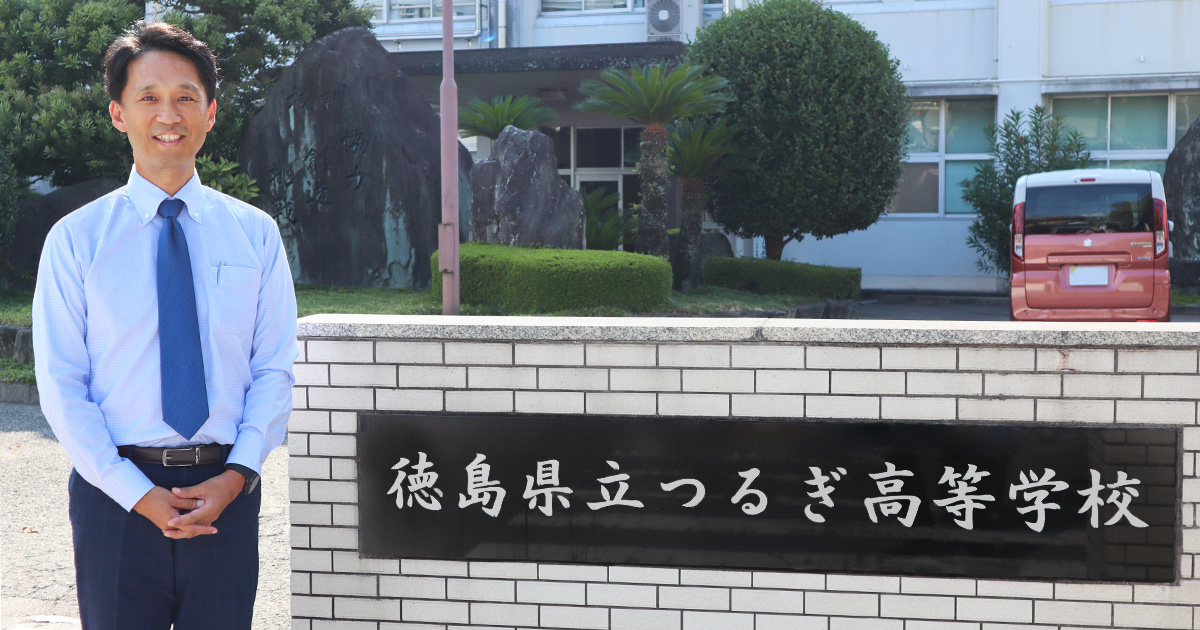
Tokushima Prefectural Tsurugi High School is a vocational high school with technical and commercial departments. The school was looking for a tool that would allow students to study independently on their smartphones, and decided to introduce learningBOX. The teacher who selected learningBOX, uses it in club activities and classes, and promotes its use in the school talked to us about his experiences in the field. The article summarizing the talks that could not be covered in the interview is posted at the bottom of this page. Please take a look at it as well.

1. to promote systematic and developmental learning that makes the most of the characteristics of each department, and to develop human resources who can contribute to society as specialists in their respective fields.
In order to nurture human resources who can independently and strongly survive in a rapidly changing society, we will nurture a rich humanity and promote career education that makes the most of each student's individuality and develops his/her potential to the fullest.
3. to promote education that respects basic human rights and fosters a rich humanity, including self-discipline, cooperation with others, consideration for others, and an inspiring spirit.
Osamu Yamada
- To improve basic academic skills of students who do not know how to learn and have low motivation to learn
- We were looking for a tool that would allow students to learn using a smartphone that they are familiar with.
- When you give students assignments, you don't know if they're actually working on them until the day they're due.
- Teachers have a heavy workload, making it difficult to expand into additional tasks such as tool implementation
- Students are encouraged to work on their own to overcome their weaknesses, leading to improved motivation to learn.
- I can study on my smartphone regardless of time and place, and it is useful for home study.
- Watching learning progress, talking to students who are not making progress, and using the percentage of correct answers to guide learning.
- We are committed to spreading the word so that we can take advantage of our achievements in quiz efficiency, grade processing efficiency, etc.
- Use your smartphone to work on assignments and exercises
- No installation required, just send us the login page URL and we'll get started right away!
- Ability to create your own questions. Can be created in form, text, or Excel.
- I was attracted by the unparalleled variety of question formats.


The original purpose of the use was to prepare for a paper test in the mountain club.
First of all, please tell us about the unique characteristics of your school.
The school is a technical high school with both technical and commercial departments, which opened in 2014 with the merger of the local technical and commercial high schools.
Our school mission is to "cultivate the skills needed to become 'specialists' who contribute to the development of the local community by acquiring solid academic skills and specialized knowledge and skills through a 'well-developed ICT educational environment' based on collaboration between industrial and commercial education rooted in the community.
We actively introduce cutting-edge technologies such as generative AI and virtual reality (VR), and place importance on fostering the ability to use information and think creatively that students will need to survive in the future.
Could you tell us about your teacher's subject matter?
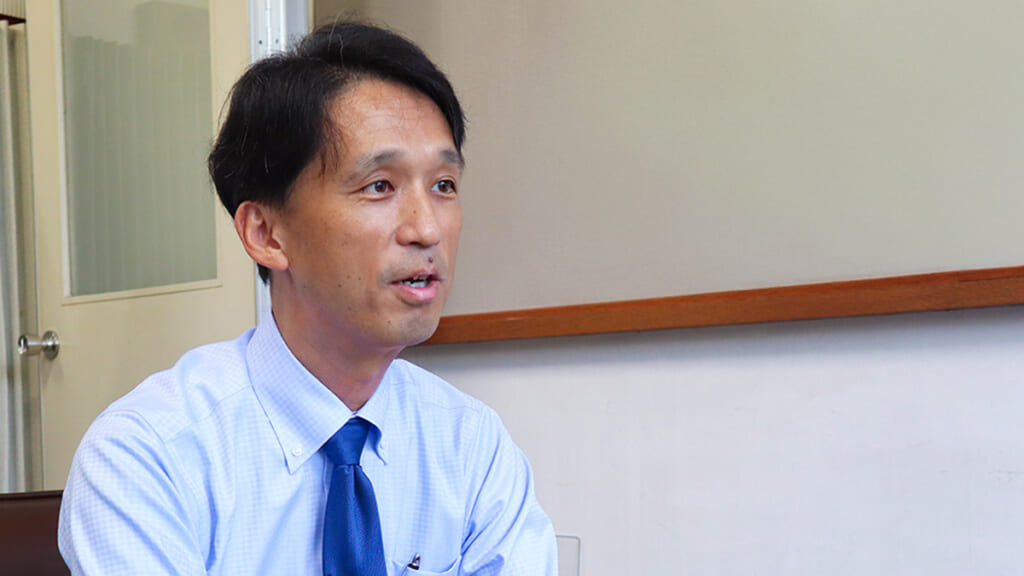
My subject is science, specializing in physics. I am currently teaching "Science and Human Life," "Basic Physics," and "Basic Biology. Science and Human Life" may not be a subject that you are familiar with, but it is a new subject that was created a while ago, and it is a subject in which students learn about science as a whole in a broad sense.
In club activities, I am an advisor for the mountain club.
How are you using learningBOX?
In fact, the first time we introduced learningBOX was for use in our mountaineering club. The mountaineering clubs have paper tests at competitions such as the Inter-High School Athletic Meet (National High School Athletic Meet).
The test is designed to test students' knowledge of weather, first aid, and mountain nature. It is specialized and there is a textbook, but just telling students to read it is not enough to get them to study.
So I decided to create my own questions from the textbook and deploy them on the learningBOX for the students to do.
For students who do not know how to learn, we thought it would be effective for them to learn not just by reading texts, but also by taking quizzes.
Convinced that the school's students were well suited for the program, the company expanded its use of the program to include academic instruction.
How was it utilized in the mountain club?
I realized that I was able to complete more problems on the paper test than before.
I was worried about whether I would be able to go into the competition with my knowledge properly established, but the learningBOX helped me a lot because it allowed me to visualize my learning progress.
If we had not introduced the learningBOX, it would have been difficult to monitor how well students were progressing and how much knowledge they were retaining.
And from there, you started to use it for subject guidance as well, is that right?
Yes, after implementing learningBOX in the mountain club, we were convinced that it was suitable for our students, so we expanded its use.
In my subject instruction, I use it as an independent study before tests. I incorporate it into all of my classes in the subjects I teach, "Science and Human Life," "Fundamentals of Physics," and "Fundamentals of Biology.
The number of students we are responsible for is approximately 150. Our school has approximately 25 students per class, which is small compared to other schools.
To improve basic academic skills of students who do not know how to learn and have low motivation to learn
What challenges did you face before using learningBOX in your academic instruction?
Our school is a vocational high school with technical and commercial departments. Unlike students in preparatory schools, a relatively large number of students are enrolled in this school who are not very good at studying.
We wanted to improve basic academic skills as much as possible for students who wanted to improve their grades but did not know how to learn or had little motivation to learn.
Therefore, we wanted to utilize a tool that would allow independent study using a smartphone.
What percentage of your school currently utilizes learningBOX?
About half of all courses use learningBOX. The percentage of students actually using the system is also about the same. Currently, only about 20% of all teachers are actively using learningBOX.
I understand that the current use of the system is not yet widespread enough. In the future, we intend to make every effort to encourage more teachers to use the system and benefit their students.
How to reduce the burden on teachers in terms of barriers to writing questions, administering quizzes, etc.
What do you see as the hurdles for other teachers to use learningBOX?
The most important thing is to create the questions on your own. The hurdle is especially high for teachers who are not good with digital technology, and we have the impression that not many teachers are willing to try their hand at creating questions.
And we feel that there are some areas that are difficult to develop in learningBOX, such as long reading comprehension in Japanese and drawing problems in mathematics.
However, since learningBOX has a wide variety of question formats, we believe that it is possible to use it on a spot basis, and that it will be helpful in consolidating knowledge.
Are there any other challenges you feel you are facing besides the composition question?
We feel that the situation is still very much a burden on teachers in various aspects.
In our school, even if we tell students to study for a test, they often do not know how to do so and do not make much progress. Therefore, I think it is important to administer quizzes frequently, but this also places a heavy burden on teachers and cannot be done frequently in all subjects.
Even in my charge, in the first-year subject "Science and Human Life," I make a generous effort to help students acquire the fundamentals by giving them several quizzes.
On the other hand, when it comes to the second-year subjects "Basic Physics" and "Basic Biology," students have become somewhat accustomed to learning in high school, so we do not conduct as frequent quizzes and detailed support as we do in the first-year courses. As a result, there may be somewhat less preparation before periodic tests.
In this context, I have recently started administering quizzes on learningBOX as well. learningBOX eliminates the hassle of paper distribution, collection, and grading, and allows me to develop quizzes even for second-year subjects. I can also check the grades at a glance, which is very convenient.
Is there anything that learningBOX can do to help reduce the burden on teachers, such as writing questions?
For example, if there is a service that converts textbooks for certification exams into a format that can be uploaded to learningBOX, more teachers would use this service.
It may be difficult because of copyright issues, but it would be nice to be able to let students use the learningBOX as an exercise.
In my subject area, when I buy a science workbook (textbook), it comes with Word data. This can be used to create test questions, etc., but it would be great if it came with text data that can be uploaded directly to learningBOX.
I see. You mean data from textbooks. I guess there are still some difficulties due to copyright issues. We also offer a question creation service to assist in the creation of teaching materials, as well as a service to convert teaching materials created by teachers to learningBOX specifications. We would be happy to discuss the details with you.
The key is the ease of not having an app and the ability to create your own questions in many question formats.
Please tell us about the process of selecting learningBOX.
Even students who find studying difficult are usually familiar with smartphones. Therefore, we thought that they would naturally accept a way to use their smartphones to work on assignments and practice problems. While searching for various tools, we found learningBOX.
I remember considering seven or eight applications, including some that I quickly determined did not meet my requirements and ruled out early on.
At that time, there were no tools such as Teams or Google Forms to create quizzes easily, so I remember searching for many quiz applications anyway. Among them, learningBOX was almost the only choice.

What attracted you to learningBOX, which is not an application? What were the deciding factors in your decision to introduce LearningBOX?
I had been looking for a quiz application for a long time, and I found it good in that it is not an application on the other hand. I thought it was convenient because there was no need to install it, and it was easy to send the learningBOX login page URL to students via the message application, and they could log in at any time.
As mentioned earlier, our initial goal was to provide the members of the mountaineering club with a basic knowledge of mountaineering. In doing so, there were two points that we felt were particularly outstanding.
The first is that you can create your own questions. Unlike the five major subjects, there are currently no applications that include questions on mountains. Second, there is a wide variety of question types. At the time, many tools offered only a choice format, but I was very interested in learningBOX because it allowed me to create questions in a variety of formats.
Improved operational efficiency and streamlined grade processing. Improved student motivation to learn.
What are the benefits of implementing the learningBOX?
First of all, the ability to efficiently create a large number of questions in text format has improved our work efficiency. It may be a little difficult to create questions in the first year, but once you have created them, you can apply them from there, which makes it easier in the second and subsequent years.
In addition, from this year, quizzes are also administered in the learningBOX, and the submission of assignments in the form of work has been eliminated. We have also changed the way we conduct the quizzes to "learningBOX."CSV exportI feel much more comfortable processing grades at the end of the year, since I only have to download the data for the grade list and tabulate it in "Grades". I am now able to respond to deadlines with more time to spare.
It has taken two classes about an hour to collect the work and check the assignments. A teacher who could take the time to look at them carefully would have taken even more time. This is no longer the case, and we have saved the time and effort of creating, printing, distributing, collecting, and grading the quizzes, as well as the space to store the finished quizzes.
I also feel that the students are developing a sense of independence. From the point of view that they did not know how to study before, they are deepening their understanding by repeatedly solving problems they made mistakes on the learningBOX. The numerical display of the percentage of correct answers also seems to contribute to maintaining students' motivation, and students are now working on their own to overcome their weak points, leading to an increase in their motivation to learn.
That was very good. Are there any other changes that have occurred as a result of the introduction of learningBOX?
Currently, the evaluation of learning status by perspective is organized into three perspectives: "knowledge and skills," "thinking, judgment, and expression," and "independent attitude toward learning" (*1).
In this context, I have taken into account how much learningBOX was implemented in terms of "proactive attitude toward learning". It is very difficult to measure "proactive attitude toward learning," and I have been struggling to figure out how to measure it, but I give points for "proactive attitude toward learning" as long as the achievement rate is 100%, regardless of the number of times the students try.
I can't see what students are learning at home, but with learningBOX, I can see them working on it, which is good.
(*1) Reference:
Ministry of Education, Culture, Sports, Science and Technology, "New High School Courses of Study and Improvement of Learning Assessment"
We want to reduce the burden and improve the quality of learning in a cross-school community.
Now, finally,What is your vision for the future?
When teachers can collaborate with each other to create questions, it reduces the burden; it is easier for two people to create 50% each than for one person to create 100%. Or even 20% each by 5 people. I think it would be even more convenient if there is a system to share content with teachers from other schools, and we would be able to create a lot more interesting content. I would like to form this kind of community among teachers.
If I were to be transferred to another school, my successor would be able to utilize the content I have created, and it would be very helpful if I could take it with me as is to other schools.
The learningBOX works well and is easy for students to work on, no problems there. Really, the only issue left is to make the problems yourself. It all depends on how we can overcome this hurdle.
We would very much like to continue our efforts for the benefit of our students with the help of everyone at learningBOX.
▼Click here for an article that summarizes the talk that could not be contained in the interview.
Thank you very much for your valuable insights!
1. to promote systematic and developmental learning that makes the most of the characteristics of each department, and to develop human resources who can contribute to society as specialists in their respective fields.
In order to nurture human resources who can independently and strongly survive in a rapidly changing society, we will nurture a rich humanity and promote career education that makes the most of each student's individuality and develops his/her potential to the fullest.
3. to promote education that respects basic human rights and fosters a rich humanity, including self-discipline, cooperation with others, consideration for others, and an inspiring spirit.
Osamu Yamada



-
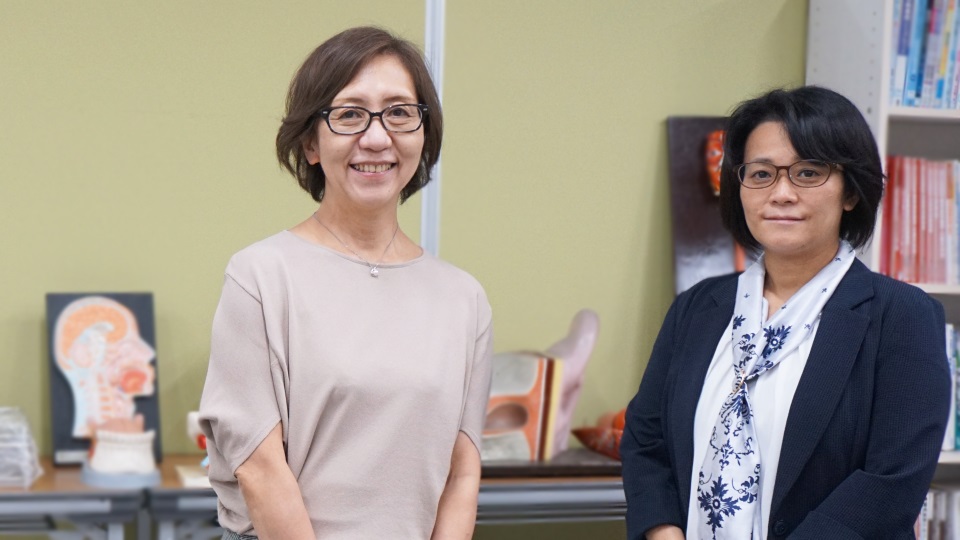 Repetitive learning in spare time is the best way to prepare for the national examSeibu Gakuen College of Medical Technology
 -
 Ideas boost efficiency. Aiming for further successNo.1 Corporation
 -
 Develop human resources who can act in the event of an actual disaster by utilizing their knowledge of systematic disaster countermeasures.Disaster Management Training Center, The University of Tokyo
-
Discover rich featuresService Guide

-
Feel free to contact usGet in Touch

-
Try our Free PlanTry Free Plan