A must-see for HR professionals] DX will change corporate internal education and human resource reform
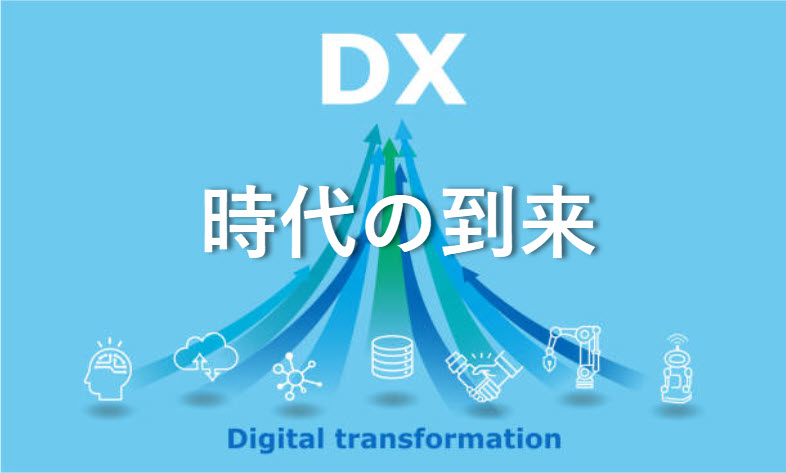
[A Must-Read for HR Professionals!] How DX Is Transforming Corporate Training and Workforce Reform My name is Takataoka, and I work in marketing. In 2020, the spread of COVID-19 presented significant challenges for businesses. Amid the pandemic, society as a whole developed a tendency to avoid “meeting people,” rendering various businesses that relied on such interactions unsustainable. The use of digital technology played an indispensable role in overcoming this crisis! 2021 is being called the “Year of DX” and is said to mark the full-scale launch of the digital revolution. DX is an essential measure for companies to survive in the future. While the COVID-19 pandemic has accelerated the adoption of remote work, it has also highlighted challenges in talent evaluation and management. Therefore, in this article, we will introduce the features of the “e-Learning × Talent Management System,” which reduces the burden on internal training and HR operations while driving efficiency. Table of Contents 1. The Era of Full-Scale DX Has Arrived for In-House Training 2. Protecting Your Company by Developing Talent Through Strategic HR Utilizing DX 3. Limited to the First 50 Companies! We Provide Comprehensive Support for Your Company’s DX Initiatives 4. Summary The Era of Full-Scale DX Has Arrived for In-House Training Due to the spread of the novel coronavirus, telework has accelerated rapidly in large corporations since last year. Even manufacturers that had not yet advanced their DX initiatives were forced to adapt, with most meetings shifting to online tools such as Zoom and Google Meet. DX is a term that represents digital transformation, referring to the use of IT to improve people’s lives. It is used as a fundamental initiative for companies to transform their business models and operations by utilizing IT technologies such as "AI, IoT, and Big Data," based on the concept of "creating new value within existing business processes and business models." ▼Click here for related articles on DX Rapid DX transformation is also advancing in the field of human resources training! Companies that primarily rely on remote work are moving their training online, utilizing e-learning and Learning Management Systems (LMS) equipped with live streaming capabilities to conduct internal training. Many LMS platforms are equipped with mechanisms and features that allow nearly all aspects of traditional training—such as attendance tracking, course completion verification, administering comprehension tests, and facilitating communication between instructors and learners—to be handled entirely online. LMS stands for "Learning Management System." As the name "learning management" suggests, it is a system originally designed to deliver e-learning to learners and manage learning histories as data. ▼This article provides a detailed explanation of LMS. Recommended for Corporate Training! E-Learning to Streamline and Automate In-House Education When it comes to corporate training, group training sessions conducted simultaneously for new employees are the most common approach. However, in recent years, “e-learning” utilizing the internet has been gaining attention. E-learning refers to “a form of learning conducted using various devices such as PCs, smartphones, and tablets,” and describes an educational style that digitizes the learning process. E-learning allows learners to progress through training at their own pace and convenience, and its adoption is expanding as part of various in-house training programs. Training programs essential for new employee orientation and internal education often involve time-consuming and costly tasks, such as schedule management and preparation by staff. Furthermore, due to the diversification of the workforce and the increasing specialization of required skills, group training where everyone receives the same content is becoming less practical. ■ Benefits of Conducting Corporate Training via e-Learning Corporate training utilizing e-learning essentially allows each individual to proceed at their own pace, anytime and anywhere, without being constrained by time or location. It allows for the use of a wider range of learning materials than traditional methods relying solely on books, reference materials, or lectures, and makes it easy to track participants’ progress and performance. E-learning creates an efficient learning environment online—something difficult to achieve with traditional in-person training—and has been widely adopted in Japan by companies and universities since the 2000s. ▼ Conducting traditional in-person training incurs the following costs: 1. Transportation costs for gathering participants at a single venue; 2. Venue rental fees; 3. Printing costs for training materials; 4. Personnel costs for external instructors. *Once the learning environment is set up, e-learning can be used repeatedly. By conducting training via e-learning, you can reduce venue costs as well as the time and expense associated with preparing and distributing materials. It also allows for flexible learning opportunities for those with irregular work schedules or mid-career hires—cases that were difficult to accommodate with in-person training. Protecting the Company by Developing Talent Through Strategic HR Leveraging DX Administrative tasks central to HR, such as talent management and performance evaluations, are highly suitable for automation and systemization. HR operations are an area where organizations can easily take the first step toward promoting DX, and major companies are rapidly introducing systems to improve internal efficiency. However, back-office operations such as HR and labor affairs have long been viewed as inefficient and cumbersome. Here, we introduce "Talent Management Systems," which are useful for data management and performance evaluations in such HR operations. Talent Management Systems enable centralized management of cumbersome data. Talent management is a concept that originated in the United States in the 1990s. A Talent Management System is an approach aimed at strategic personnel placement and talent development by centrally managing and utilizing data on employees’ abilities, qualities, technical skills, and experience. In Japan, it gained widespread recognition in the 2010s as the shrinking labor force became a growing concern. A key feature of Talent Management Systems is that they visualize employee capabilities, enabling the right people to be placed in the right roles and facilitating effective talent development! How to Utilize a Talent Management System ▼Here are specific ways to utilize a talent management system once it is implemented. 1. Boost employee morale by visualizing engagement. 2. Enable strategic talent development and placement. 3. Eliminate waste in HR operations. 1. Boost employee morale by visualizing engagement. Engagement refers to an employee’s “attachment” or “commitment” to the company. Improving employee engagement is gaining attention as a critical challenge for companies to ensure their continued survival. According to research findings from the Motivation Engineering Institute on “Engagement and Corporate Performance,” improving engagement has a positive impact on employee productivity. The implementation of a talent management system can be used to visualize employee engagement, making it effective for HR and corporate management. Point 2: Enabling Strategic Talent Development and Placement The greatest benefit of a talent management system is that it enables “objective and comprehensive competency assessments of employees.” Under traditional evaluation systems, assessments were often determined by a supervisor’s judgment or perception, and it was not uncommon for employees to be unable to fully utilize their true capabilities. With a system in place for centralized data management, it becomes easier to conduct fair evaluations based on data from a comprehensive perspective, rather than relying on someone’s biased judgment. 3. Streamlining HR-Related Workflows By centralizing data that was previously managed across various platforms such as Excel and paper, HR-related tasks can be significantly simplified. Since everything can be managed in one place online, there is no doubt that this will drastically improve efficiency compared to traditional management methods! Streamlining HR operations frees up resources that can then be allocated to other business activities. Limited to the first 50 companies! We provide comprehensive support for your company’s DX initiatives. Tatsuno Information Systems Co., Ltd. (Headquarters: 216-1 Domoto, Tatsuno-cho, Tatsuno City, Hyogo Prefecture; President and CEO: Yoichiro Nishimura; hereinafter “Tatsuno Information Systems”) has decided to participate as a “Collaboration Partner” in the “Kaonavi Connected Partner Program” provided by Kaonavi Inc. (Headquarters: Minato-ku, Tokyo; President and CEO: Hitoshi Yanagibashi). To commemorate this collaboration, Kaonavi and learningBOX—both of which support digital transformation (DX)—are launching a limited-time campaign! Kaonavi: Uncovering Employee Individuality and Talent to Accelerate Strategic HR Kaonavi is a talent management system that uncovers employee individuality and talent to accelerate strategic HR. By centrally managing and visualizing employee information—such as faces, names, experience, evaluations, skills, and talents—it supports the implementation of strategic talent management tasks, such as optimal staffing and promotion. As HR technology that solves all talent management challenges and enables corporate work-style reform, it has been chosen by executives and on-site management at over 1,900* companies across all industries and business types. *As of September 30, 2020 (Official website: https://www.kaonavi.jp) learningBOX is an e-learning system designed with a focus on ease of use and affordability. learningBOX is a Learning Management System (LMS) that covers all functions—including course creation, question and test creation, grading, and grade management—enabling you to create e-learning materials with a focus on affordability and ease of use. You can create questions for quizzes and tests using 13 different question formats, and it is also possible to create the web version of the classic memorization tool "Red Sheet"—"Fill-in-the-Blank Notes"—as well as original typing materials. (Official Website: https://learningbox.online/) Campaign Period: Starting Thursday, April 1, 2021—limited to the first 50 companies! Achieve greater visibility and impact with "Talent Management" × "e-Learning"! Kaonavi and learningBOX, both supporters of Digital Transformation (DX), are holding a limited-time campaign to commemorate their collaboration. Campaign Highlights 1. Centralized management of internal training records and results linked to employee information 2. Streamline HR management tasks involving vast amounts of data 3. Improve the efficiency of performance evaluations and internal training through system integration 4. Get started with both services at a special rate 5. Sign up for a consultation and receive a free original candy gift! ▼If you’re interested, please visit the campaign page via the banner below. Summary In this article, we introduced the features of the “e-Learning × Talent Management System” designed to reduce the burden of internal training and HR operations while driving efficiency. Due to the impact of COVID-19, IT adoption has accelerated across society, and the demand for online training is on the rise. For companies to continue growing, it is crucial to create mechanisms that foster an organizational culture and mindset where every employee is flexible, willing to take on new challenges, and committed to learning. In recent years, the need for digital transformation has been growing in Japan as well. This is not limited to large corporations; small and medium-sized enterprises face the same challenges. With the start of the new fiscal year, we understand that many companies are conducting training for new employees. With so many things to manage, aren’t your administrative tasks just piling up? By combining e-learning with a talent management system, you can easily centralize the management of internal training and performance evaluations—tasks that used to be so difficult. Our e-learning system, “learningBOX,” is an LMS that can integrate with talent management systems.
 Choose the Right System to Train Global Talent - 3 key factors for SMEs
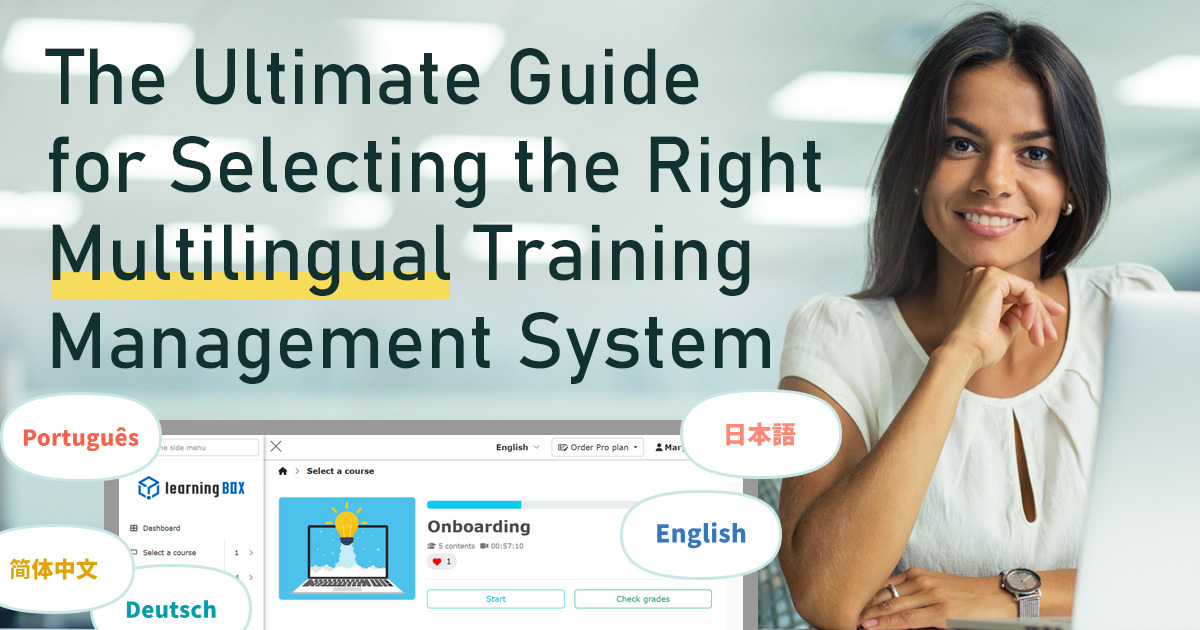 The Ultimate Guide for Selecting the Right Multilingual Trainng Management System
 Human Resource Development Grant for e-Training
 Memorization Strategies
 How to Create Your Own Aptitude Test