Summary of Subsidies and Grants for Introducing E-Learning [2025 Edition]|The Latest Guide to "Subsidies for Supporting Human Resource Development" and "Subsidies for IT Introduction 2025" for Both Improving Business Efficiency and Human Resource Development
In recent years, the introduction of e-learning systems and LMS has been rapidly increasing among companies and organizations due to the promotion of work style reforms and educational DX. Many of you may be considering the best e-learning system to introduce or replace your existing one.
While the use of e-learning is attracting attention from the perspective of improving operational efficiency and human resource development, the introduction cost and operational burden are often issues to be addressed. What we would like to take advantage of are the subsidies and grants provided by the national and local governments. There are a number of programs that support the introduction of e-learning, such as the Human Resource Development Support Subsidy and the IT Subsidy 2025.
In this column, we will explain in detail the main types of subsidies and grants that can be used to introduce e-learning, their overview, key points for selecting an e-learning system and LMS (Learning Management System), and systems that are compatible with the subsidies and grants. If you are thinking of introducing e-Learning by utilizing subsidies and grants, please read to the end.
The content of this article is current as of June 2025.
(*1) Reference: Yano Research Institute Ltd., "Survey on e-Learning Market (2025)".
learningBOX supports both "Human Resource Development Support Subsidy" and "IT Introduction Subsidy 2025".
Free consultation with our professional staff
Click here to view the learningBOX document that corresponds to the Human Resource Development Support Subsidy.
Download Now
What is the difference between grants and subsidies, and what are the advantages of utilizing them?
Grants and subsidies are funds provided by the national or local government that, in principle, do not need to be repaid. This section explains the differences between grants and subsidies, the advantages of using grants and subsidies for e-Learning and LMS implementation, and points to consider when applying.
Difference between grants and subsidies
Both grants and subsidies are provided by the national or local government to companies or individuals, but there are differences in their purpose and nature.
About Grants
The main purpose of the subsidy is to stabilize the working environment, and is a system to financially support businesses that promote and maintain employment, develop human resources, and improve the working environment. The Ministry of Health, Labour and Welfare (MHLW) has the main jurisdiction over this program, which is financed by unemployment insurance premiums.
About the subsidy
Subsidies are programs under which the national government and local governments provide funds to companies and businesses for the purpose of supporting new businesses, regional development, and the promotion of public welfare projects. They are mainly administered by the Ministry of Economy, Trade and Industry (METI), other ministries and agencies, and local governments to support new businesses, start-ups, and employment stability. It is mainly financed by taxes.
In principle, grants can be received if the requirements are met, whereas subsidies have a fixed budget and number of applications to be adopted, and applications do not always result in the receipt of grants. Subsidies have a high ratio of applicants, and it is necessary to demonstrate the need for the project.
About the amount of benefits
Regarding the amount of benefits, grants generally range from a few hundred thousand yen to a few million yen at most, while subsidies are characterized by their larger scale, with budgets sometimes reaching billions of yen.
Grant and subsidy programs are frequently revised. Be sure to check the official websites of each ministry and local government for the latest information.
Advantages of using subsidies and grants for e-Learning and LMS implementation
The benefits of utilizing grants and subsidies for e-Learning and LMS implementation include the ability to create a state-of-the-art educational environment while reducing the cost burden. As a result, companies and organizations can implement high-quality systems within their budgets and effectively improve the skills of their employees and staff.
In addition, the use of subsidies and grants can lower the hurdles to implementation and enable systems to be deployed quickly. Another major advantage of receiving support is that it allows for competitive human resource development while reducing the risk of long-term educational investment.
Key Points for Subsidies and Grants <Application
There are four important points to keep in mind when applying for grants and subsidies.
1. Confirm the purpose of the program
Make sure that the project you are applying for conforms to the purpose of the subsidy or grant system. Projects that deviate from the purpose of the program are unlikely to be adopted, so prior confirmation is essential.
2. Allow plenty of time for preparation.
It is important to allow plenty of time for application deadlines and preparation of required documents. Missing deadlines will prevent you from applying, and incomplete documentation will lead to delays or rejection of your application.
3. Plan your financing
The full amount of subsidies and grants are not immediately available, and it is necessary to prepare personal funds and understand the period of time until the funds are provided. To ensure that you do not run out of funds when your project is implemented, consider financing in a systematic manner.
4. Fraudulent receipt of funds is absolutely prohibited.
It is important to accurately understand the requirements and rules, as unauthorized receipt of benefits will be severely punished. If you have any questions, consult with the grant or subsidy office or a specialist.
If you are uncertain about the application or preparation, it is also effective to consult a professional social insurance consultant. Receiving professional support will improve the certainty and speed of your application, and as a result, save you time and effort.
Typical subsidies and grants that can be used for e-Learning and LMS implementation
The following are two types of representative grants and subsidies from the national and local governments that can be used for e-Learning and LMS implementation.
Subsidy for Human Resource Development Support
IT Introduction Subsidy 2025
Each grant or subsidy is described in detail in the next section.
Please feel free to inquire about how much assistance you may be eligible for with the installation of a learningBOX!
Free Consultation
Back to Table of Contents
Subsidy for Human Resource Development Support
The "Subsidy for Supporting Human Resource Development" is a system provided by the Ministry of Health, Labour and Welfare to support human resource development of companies. If you are considering a reskilling training program that is eligible for the "Human Resources Development Support Subsidy," please take a look at the following information.
Outline of the "Subsidy for Supporting Human Resources Development
The "Subsidy for Supporting Human Resource Development" provides subsidies for training expenses and part of the wages during the training period, when employers implement vocational training, etc. according to a plan in order to have their employees acquire specialized knowledge and skills related to their job content.
The following six courses are available as subsidies for human resource development.
Human resource development support course
Course for granting educational and training leave, etc.
Course for Promotion of Investment in Human Resources
Business development reskilling support course
Certified Construction Worker Training Course
Technical Training Course for Construction Workers
Ministry of Health, Labour and Welfare, "Subsidy for Human Resource Development Support
Courses for which e-learning is covered by the "Subsidy for Supporting Human Resources Development
The "Subsidy for Supporting Human Resources Development" includes six courses, of which e-learning is covered in the "Course for Supporting Human Resources Development," "Course for Promoting Investment in Human Resources," and "Course for Supporting Reskilling of Business Expansion, etc.". In the case of e-learning, only the cost is covered by the subsidy.
Human Resources Development Support Course
The "Human Resource Development Support Course" provides subsidies for training expenses when training is conducted in accordance with a training plan in order to help employees acquire knowledge and skills related to their jobs. The following three training programs are available
Human Resource Development Training
Vocational Training with Authorized Practical Training
Fixed-term practical training
In the case of "human resource development training," e-learning training is also eligible for subsidies. Some "approved vocational training with practical training" and "fixed-term practical training" may be eligible for subsidies. For details, please refer to the "Guide to the Human Resources Development Support Subsidy (Human Resources Development Support Course).
Course for Promotion of Investment in Human Resources
The "Course for Promotion of Investment in Human Resources" was realized based on a proposal from the public in order to accelerate investment in human resources. The subsidy will be provided for a limited period from fiscal year 2009 to fiscal year 2026. The following five types of training programs are available, all of which include e-learning training.
Training for highly skilled digital human resources/training for human resources in growing fields, etc.
Vocational training with approved practical training in the field of information technology
Fixed-price training
voluntary job skills development training
Long-term education and training leave system
For details, please refer to the "Subsidy for Human Resource Development: Investment in Human Resources Promotion Course (Detailed Version)".
Reskilling Support Course for Business Expansion, etc.
The "Business Development and Other Reskilling Support Course" is designed for training associated with business development such as launching a new business, DX (Digital Transformation), and GX (Green Transformation) to reduce carbon dioxide emissions.
The subsidy covers training expenses for employers to provide their workers with the knowledge and skills needed in new fields, when such training is carried out in accordance with a plan. E-learning training is also eligible for this subsidy. For details, please refer to the "Subsidy for Human Resource Development Support (Reskilling Support Course for Business Expansion, etc.) (detailed version)".
There are various requirements for employers who are eligible to use the "Subsidy for Supporting Human Resources Development" and for the training to be provided. For details, please check the latest information on the Ministry of Health, Labor and Welfare website and prepare accordingly.
What kind of e-learning system satisfies the requirements for the "Human Resource Development Support Subsidy"?
First, it is important to understand what kind of e-learning system or LMS (Learning Management System) is required for the grant that you wish to receive. In the case of the "Human Resource Development Support Grant," there is no specification for the system to be covered, so you can choose the system that best fits your company. Below is a list of the features that are required.
Fixed-price services are not eligible for some courses.
Please note that subscription-based services (subscription-type services) are not eligible for subsidies under the "Human Resource Development Support Course.
Progress management and proof of completion of training are important.
In the case of e-learning training, what is important is the ability to prove that trainees have completed the course. In addition to the ability to manage the progress and completion status of trainees, the system must be able to provide a certificate of completion and course history upon completion of the training.
Tracking of course hours is possible.
Since training must be conducted during workers' working hours, it is necessary to keep track of the hours of attendance. Be able to prove that training is being conducted during working hours.
Smoothly output data.
Within two months from the day after the end of the training, the applicant must submit the necessary documents, such as an application for payment. Since it is also necessary to submit LMS data such as documents proving completion of the course and course history, it would be useful to have a function that enables smooth output of the necessary data.
There are many functions that not only satisfy the application requirements, but also ensure that the person is taking the course and reduce operational man-hours, so please refer to them when selecting an e-learning system. It is best to inquire in advance whether the system or LMS you wish to introduce is compatible with the "Human Resource Development Support Subsidy.
Click here for learningBOX materials that are compatible with the Human Resource Development Support Subsidy.
Download Now
Back to Table of Contents
IT Subsidy 2025
The IT introduction subsidy is a system under which the government subsidizes a portion of the cost of introducing IT tools to small and medium-sized enterprises (SMEs) and small businesses. This section provides an overview of the program and explains the "Regular Quota" for which e-learning systems are eligible.
Outline of the IT Subsidy 2025
The IT introduction subsidy is a system to support the introduction of IT tools (software, services, etc.) to improve business efficiency and promote DX, with the aim of improving labor productivity of small and medium-sized enterprises and small businesses.
The IT tools (software, services, etc.) eligible for subsidies under the "IT Introduction Subsidy 2025" are limited to those that have been reviewed by the secretariat in advance and registered and published on the official website (excluding the IT introduction framework for multi-company cooperation).
Small and medium-sized enterprises (SMEs) and other subsidy applicants wishing to apply for the subsidy must form a partnership with an "IT introduction support provider" registered with the IT Introduction Subsidy Secretariat and jointly apply for the subsidy (except for the IT introduction framework for multi-company partnerships).
Please refer to "Eligibility for Application" of the "Subsidy for IT Support Program for Service Productivity Improvement" (IT Introduction Subsidy 2025) Secretariat for information on eligible businesses.
Normal quota" for which the e-learning system is eligible
There are five application slots for the "IT Subsidy 2025" as follows
Normal Quota
Invoice frame (invoice-compliant type)
Invoice (Electronic Transaction Type)
Security measure promotion quota
Multi-Company IT Deployment
The following is a detailed explanation of the "Regular Quota," which covers e-learning systems. Examples of e-learning systems include LMS (Learning Management System), educational management systems, online training platforms, and internal educational content delivery systems.
The "Regular Quota" of the "IT Subsidy 2025" is intended to support the improvement of labor productivity by subsidizing a portion of the costs for small and medium-sized enterprises (SMEs) and small businesses to introduce IT tools that meet their challenges and needs. The subsidy rate and amount are as follows The subsidy amount varies depending on the number of processes (number of business steps).
Subsidy amount
50,000,000 yen to less than 1,500,000 yen
1.5 million yen to less than 4.5 million yen
Functional Requirements
1 process or more
4 processes or more
Subsidy rate
1/2 or less *The number of employees who have been employed for more than 3 months at the minimum wage of the region plus 50 yen or less.
If the number of employees employed for more than 3 months within 30 percent of the total number of employees, the subsidy rate will be 2/3 or less.
Expenses eligible for subsidy
Software purchase cost, cloud usage cost (cloud usage fee for up to 2 years),
Installation-related expenses
Installation-related expenses include maintenance support, manual preparation, and other costs, as well as post-introduction "utilization support" to promote the establishment of IT utilization.
The requirements for IT tools are software with one or more of the business processes shown in the figure below (only generic processes are not acceptable).
For details on the "Regular Quota", please refer to the "IT Introduction Subsidy 2025 Application Procedure (Regular Quota)" of the "Subsidy for IT Introduction Support Project for Service Productivity Improvement" (IT Introduction Subsidy 2025) Secretariat.
For subsidy application, please ask for support from "IT Installation Supporting Business
In applying for an "IT introduction subsidy," the company that is the target of the application and the vendor that provides the IT tool (IT introduction support provider) need to apply jointly.
In addition, only IT tools that have been registered and certified by the IT implementation support provider are eligible for the application and subsidy. IT tools and IT tools that have been adopted by the Secretariat for the "IT Introduction Subsidy 2025" can be searched from the "IT Tool/IT Introduction Support Business Operator Search" of the "Subsidy for IT Introduction Support Project for Improving Service and Other Productivity" (IT Introduction Subsidy 2025) Secretariat.
When considering the introduction of a system that meets the project purpose of the "IT Introduction Subsidy," make sure that the IT tool is eligible for the subsidy application. We recommend that you choose a partner (IT implementation support provider) with a system that can provide solid support from smooth application procedures to reporting work.
Please feel free to consult with us about system introduction utilizing the IT introduction subsidy.
Free Consultation
Back to Table of Contents
Take advantage of grants and subsidies to implement the best e-learning system!
Up to the previous section, we have introduced grants and subsidies that can be used to introduce e-learning. From here, let's take a look at e-learning systems. We will also introduce cost rates, ways to reduce costs, and recommended e-learning systems.
Cost Breakdown of e-Learning
There are a variety of costs involved in implementing eLearning. Let's take a look at some of the specific costs involved.
Initial Cost
This is the cost to install the system and build the environment. Fees vary widely depending on the form of the system.
Usage Fees
Monthly or annual service fees, which vary depending on the number of students and length of use.
Customization Fee
This is the cost of adding functions or redesigning the system to meet the company's needs.
Optional costs
Refers to costs associated with the use of additional features, support services, etc.
Cost of teaching materials
This is the cost of purchasing existing educational materials, outsourcing, or creating educational materials in-house (labor costs, etc.), and varies depending on the quality of the content and the scale of production.
It is important to comprehensively consider these costs and select the most appropriate plan.
E-learning system cost rates and three ways to reduce costs
Are you finding that implementing e-Learning is more expensive than you thought...? Here are three specific ways to get started smoothly with eLearning while keeping costs down.
1. Introduce a cloud-based system
There are several types of e-learning systems and LMSs, including cloud-based systems (systems provided on an online server) and on-premise systems (systems built on the company's own servers). Cloud-based systems require less time to implement and are less expensive.
2. Wisely choose a plan that fits your company's needs
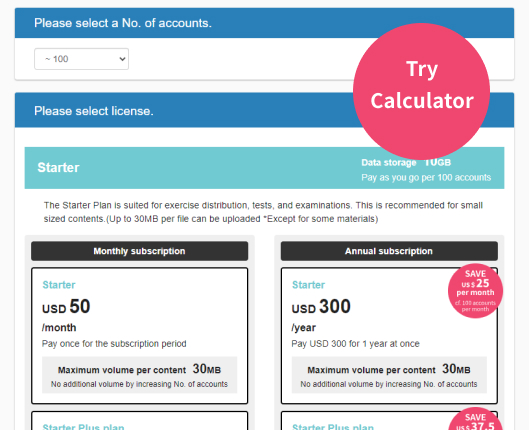
Most e-learning systems cost either on a pay-as-you-go basis, a fixed monthly fee, or an annual contract. The most common cost range is between 30,000 yen and 60,000 yen per month for up to 100 users, and between 50,000 yen and 80,000 yen per month for 200 users. Calculated on a per-user basis, the cost is 250 yen to 600 yen per month.
However, since these prices vary depending on the service content and contract conditions, when considering specific introduction, carefully check the plan content and select the most appropriate plan according to the frequency of use and number of users.
3. Create your own teaching materials
By creating instructional materials in-house using PowerPoint and other tools, you can reduce the cost of outsourcing and purchasing instructional materials. In addition, the company can flexibly create educational materials according to its own learning content and goals, and can quickly revise and update the content. This enables efficient operation of training materials while reducing the high costs associated with hiring a production company.
Today, many companies offer a variety of e-learning services, with a wide range of functions and prices. Therefore, many people may be at a loss as to which service to choose. First, you should start by clarifying your company's requirements before comparing numerous services.
By creating an implementation plan that meets your company's requirements, you will have a clear criteria for selecting a system, and you will be able to smoothly make internal proposals and explain them to other departments.
learningBOX supports subsidies and subsidies|Total support for introduction and application
The e-learning system "learningBOX" supports the requirements for the three courses of the "Human Resource Development Support Subsidy": "Human Resource Development Support Course," "Human Resource Investment Promotion Course," and "Business Expansion and Other Reskilling Support Course.
In addition, the e-learning system "learningBOX" has been certified as an eligible tool for the "IT Introduction Subsidy 2025. We also have an application support system in place in cooperation with a specialist labor and management office, so that even first-time applicants can use the system with confidence.
The e-learning system "learningBOX" is a domestically produced system with more than 700,000 registered users and more than 1,500 companies using it (as of the end of March 2025). It is easy to create e-learning programs even without specialized knowledge, and in addition to reducing training management costs and time, the system has also been recognized for its tangible effects, such as uniform quality of education and visualization and quantitative evaluation of learning outcomes.
Click here for a 5-minute introduction to the learningBOX service.
Free Download
LearningBOX Application Examples
The e-learning system "learningBOX" is used for employee training, training management, hiring and promotion exams, knowledge sharing, and more, regardless of industry or sector.
LearningBOX is a system that has a proven track record of application for "Human Resource Development Support Subsidy".
LearnBOX and the subsidy are combined to develop a new reskilling business → Click here to see the case study of Chipper Corporation.
Success stories in employee training
■ Reduction of Time & Cost in Training Operation At a company that provides support for the preparation and disclosure of legal disclosure documents, etc., mainly for listed companies, the replacement of an e-learning system has reduced the workload for checking unattended courses by 97%. In addition, internal data shows that the company was able to reduce 60 hours in the operation of compliance training, which resulted in a cost savings of about 1.5 million. →Click here to see the case study of PRONEXUS Inc.
Switching from group training to online training has improved training management efficiency.
Widely used in areas such as internal training, manual creation, and test preparation → Click here for the case study of No.1 Co.
Other examples of e-learning system "learningBOX" use can be found on the "Case Studies" page.
Back to Table of Contents
SUMMARY
We have introduced grants and subsidies that can be used to introduce e-learning. It is important to carefully check the requirements and procedures of each program and effectively utilize the support that meets your company's objectives. We hope you will proactively consider introducing e-learning to accelerate your business efficiency and human resource development.
The e-learning system "learningBOX" has a full support system and functions that are compatible with both the "Human Resource Development Support Subsidy" and the "IT Introduction Subsidy 2025," making it possible to proceed smoothly from introduction to application. Please make the most of the subsidies and subsidies to ensure the success of your company's e-learning implementation.
Please feel free to consult with us about learningBOX introduction utilizing subsidies and grants.
Free consultation with our professional staff
If you are in a hurry, you can also contact us for a web meeting
Specify a date and time
▼ We also recommend this one! Also read.
Back to Table of Contents



 How can AI Improve your Workplace Efficiency?
 How can AI Improve your Workplace Efficiency?
 How to Create Your Own Aptitude Test
 How Much Does an LMS Cost?
 Is a free LMS practical? Explaining how to install and what to look out for