Admin Blog

77 articles

How to support learners' metacognition through e-learning

Hello, my name is Morishita from the Development Department. I am a new programmer who has been with the company for two months. Let me start by asking, have you ever heard of "metacognition"? Metacognitive ability" is now attracting attention as it is reputed to be effective in improving work ability. What kind of ability and why does it enhance work performance? In addition to work skills, there are other factors necessary for efficient work. One of them is "metacognition. This paper introduces the relationship between "metacognition" and "e-learning. Click here for Table of Contents 1. what is metacognition? 2. why is metacognition attracting attention in the field of learning? 3. the relationship between e-learning and metacognition 4. learningBOX has many functions to promote metacognition! 5. summary What is metacognition? Metacognition is the ability to objectively evaluate one's own thoughts and actions from a higher perspective by taking a step back. Since its concept was proposed by J.H. Flavell in the 1970s, it has been widely recognized in fields such as psychology, brain science, and education. If we can properly evaluate our own learning activities, we can continue to learn effectively. This is often explained by the concept of "metacognition. Recently, a joint study by Benesse Holdings and the University of Tokyo (press release in March 2019) was conducted and, to our surprise, the study reported that high school students whose grades increased had (came to have) "metacognition" to view their learning objectively. Did you know that "metacognition" is related to higher grades? According to these studies, being able to "understand what you don't understand" and being aware of "what you are working for" are extremely important for smooth progress in learning. In addition, Endo (2018) of the University of Fukui describes self-evaluation in learning as "metacognitive activity" as follows  People check and inspect their own cognitive processes as metacognitive monitoring, and then, based on the monitored results, improve and adjust their cognitive activities as metacognitive control. This metacognitive activity is the core of self-evaluation activity.                           Koji Tanaka (ed.), Takahiro Endo (2018). Understanding Educational Evaluation, 2nd Edition, Minerva Shobo (V-5. Children's Self-Evaluation, p. 61). Models of metacognitive activities You have another self observing (monitoring) yourself from one higher perspective and modifying (controlling) your thoughts and actions. This is also true in our daily lives when we view ourselves objectively and try to control our words and actions, etc. Why is metacognition gaining attention in the learning field? In the first place, human beings have the ability to. Not many people can evaluate themselves objectively (it is very difficult). The same can be said about study and learning. Because they are not able to "objectively" evaluate their learning goals and learning status. ⇒This is why "meta-cognition" is attracting attention. While you are in school, your teachers evaluate you. When you become a member of society, "senior employees" instruct you on the knowledge and skills necessary for work and the rules for working adults. In larger companies, there may be "OJT staff" or a "mentor system". However, it is usually rare to have someone who is always there to evaluate your learning progress. Especially the more complex the task is, the more you will need to judge and correct yourself many times to see if the work and your way of doing it are really appropriate. Improved metacognition has a significant impact on learning effectiveness. Here are some examples of how metacognition has affected learning effectiveness. Case 1: "Metacognition" Tracking the Same High School Student for Three Years Effectively Increases Grades Using three years of high school tracking data (703 children) of children who graduated from high school in March 2018, we looked at the changes for each child, and found that high school students whose grades increased had (or had come to have) an intrinsic motivation to learn and goals for the future. In addition, high school students with higher grades were found to have (or have come to have) "metacognition" ("metacognitive strategies") to view their own learning objectively. This trend was particularly pronounced among those who had been accepted to difficult-to-enter universities, suggesting that the presence or absence of metacognition is effective in achieving high learning outcomes, such as higher grades and university acceptance. (Reference: Benesse Education Research Institute) Case 2: Metacognition is involved in the environment and work necessary for the process of children's growth It was found that children whose grades changed "all the way up" or "rose" from the second to the third year of high school were more likely to utilize study methods (metacognitive strategies) such as "redoing questions they got wrong on tests" and "studying while checking what they do not understand. In addition, children whose grades "rose" were more likely to utilize these study methods. (Reference: "Metacognition" is effective in raising grades) Review of Metacognitive Skills POINT Enhancing metacognitive skills will develop the ability to analyze what is known, and to evaluate and provide feedback on the setup and work processes necessary to solve problems. Appropriate monitoring and control is expected to enhance learning effectiveness. If the learning objectives are vague, it is difficult to know how to study. Another reason for frustration is that the scope of the study is not clearly defined, or that students start with things that are too difficult. Have you ever thought, "I thought I studied pretty hard, but I didn't learn as much as I thought I would..."? Have you ever had such a situation? This may be because you are not able to evaluate and grasp your own learning situation in detail. Relationship between e-learning and metacognition ☑POINT E-learning can enhance metacognitive skills necessary for learning. E-learning systems can quantify and visualize performance data and learning status. E-learning systems can be set up to match the learner's level and goals. The system can also be used to analyze the results of the study, and to identify at a glance the type of learning process of each individual (e.g., rush-into, habit-forming, and run-away-from-the-moment types). ➡You can "further enhance your meta-cognitive abilities" by understanding your own learning progress and arrangements! It is difficult to keep learning while keeping metacognition at a high level at all times. e-Learning, by playing a part in metacognitive activities, will help learners improve their metacognition, which in turn will lead to more effective learning outcomes. learningBOX has a full range of features that can promote such metacognition! With learningBOX's grade management function, you can easily check the learner's learning progress information. Learning status and grade dating can be quantified and graphed to support accurate monitoring of learners. Individual grade information can also be checked immediately. In this article, we will introduce the system using the "Information Security Training" used in Tatsuno Information System's training programs. By actively using e-learning for learning activities, it is possible to accurately visualize the learning status each time. This not only stabilizes the accuracy of monitoring, but also reduces the burden of monitoring on the learners themselves, giving them more time to focus on appropriate control and higher-level monitoring (their own more detailed thought process), which is expected to support the improvement of learners' metacognition. Recommended features of learningBOX Learners can easily check grades and learning progress on their smartphones! →The grade management function allows learners to visualize their learning status! Learners' grades and learning status can be utilized as materials for course creation! →Easy to create courses and set up groups according to the learner's level! The ability to create questions to check comprehension for tests and examinations is amazing! →Even those who are not good at computer operation can create quizzes and exam questions from the day they read the manual! learningBOX has many more features to support and follow up your learners' education than just grade management! You can learn more about the functions and how to set them up on the usage page here. If you want to promote metacognition, please register as an owner of learningBOX now! Conclusion In this article, we have introduced the metacognitive skills necessary for effective work. In order to produce effective learning outcomes, appropriate self-assessment is necessary. Metacognitive activities, the core of self-evaluation, should be based on the results of "monitoring (confirmation and inspection)" and "control (improvement and adjustment). e-Learning visualizes (data) the learning status and supports accurate monitoring of learners.

SCORM Wrapper / SCORM Wrapper

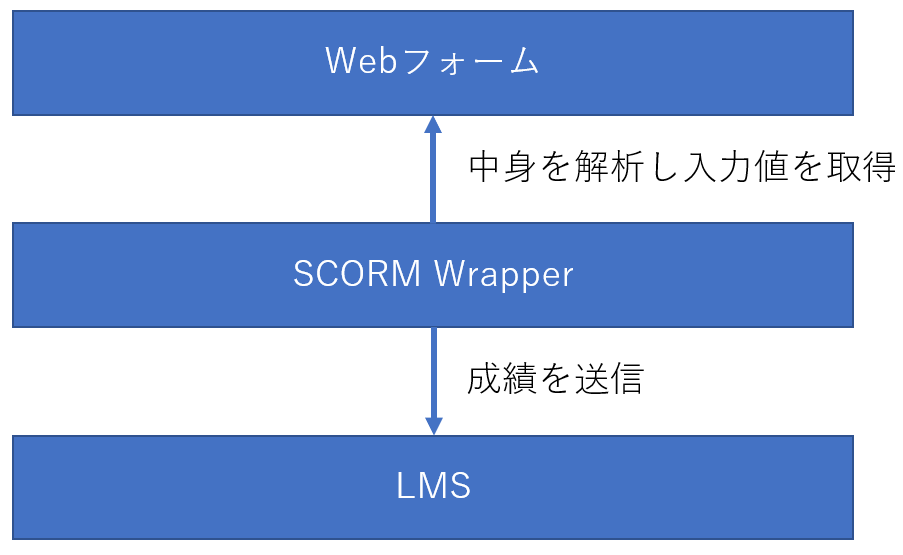
I am Nishimura and I started to create QuizGenerator in 2011. I am not able to update it, but there was a time when I was a certified SCORM Assessor, so I kind of understand SCORM. QuizGenerator is useful, but it has its limitations. QuizGenerator is a SCORM-compliant e-learning tool that allows you to create a variety of exercises, tests, and quizzes without having to worry about SCORM, but it still has its limitations. If you are a strong web programmer, you can implement SCORM relatively easily by referring to the article "Let's make SCORM materials". However, if you are a web programmer, it is relatively easy to implement SCORM. However, if you can do web design, but not programming, or if you can program a little, but learning SCORM is too much of a hassle, it may be too much of a burden for you. For those people, we recommend the SCORM Wrapper. The SCORM Wrapper makes it easy to create SCORM-compliant teaching materials. I have never heard of SCORM Wrapper. You're probably right. The name of our development code, or rather the name of our internal system, is SCORM Wrapper, but there is no mention of it in the learningBOX or on the instruction page. The reason why it is not mentioned is that the name "SCORM Wrapper" is not easy to convey to customers for marketing reasons. From a developer's point of view, the SCORM Wrapper is a tool to wrap web forms and bring SCORM APIs to life, so it is nothing more than a SCORM Wrapper. However, since we are not proposing any use beyond the questionnaire at present, it has been spoiled as a questionnaire. In any case, the questionnaire material is a SCORM Wrapper, which means that it can be used to create more than a questionnaire. What is the SCORM Wrapper? The SCORM Wrapper is, simply put, a dream tool for making web forms SCORM-compliant. Schematically, the SCORM Wrapper analyzes the contents of a web form, finds the INPUT tags, SELECT tags, TEXTAREA tags, etc., and submits the results according to the SCORM standard. Elements that the SCORM Wrapper targets for submission The SCORM Wrapper does not actually need FORM tags, although we have mentioned that the SCORM Wrapper will send the value of any of the following HTML elements, both inside and outside of a FORM, for which the name attribute is specified. input[type=text]. input[type=number] input[type=password]. input[type=date] input[type=month input[type=month]. input[type=email]. input[type=hidden]. input[type=radio]. input[type=check]. textarea select Sending grades according to the name attribute Grades are sent according to the name attribute. For example, if there is a tag , the value entered there will be sent as q1. In practice, the value of the name attribute is setValue for cmi.interactions.n.id. Behavior when a special value is entered for name If you put a special value in name, it has a special meaning. Names ending in _result If you give a name ending in _result, it will be sent as the result of the field without the _result. For example, if there is a field named "answer1" and you have a response entered there, the field named "answer1_result" will be treated as a result for answer1. The result can be set to "correct", "strong", "unanticipated", "neutral", or "decimal", and corresponds to cmi.interactions.n.result as a SCORM element. __score__. A value representing the score. in SCORM 1.2, the rule is to specify an integer from 0-100, but learningBOX also accepts values greater than 100. Decimals are not allowed. __lesson_status__. Indicates pass/fail and progress. Please set the appropriate value from the following four values. If not set, completed will be sent. incomplete: learning is in progress completed: study completed (default value) passed: passed failed: failed __duration__. Represents the training time. If this element is not present, SCORMWrapper will send the measured value. If you think the time measured by SCORMWrapper is not accurate enough, pass the elapsed time in integer seconds to __duration__. SCORMWrapper's automatic measurement is taken from the moment the material is The time from the moment the material is loaded to the moment the grades are sent is measured. If you have a start button in the material and want to measure the exact time between pressing it and answering the last question, you can implement a time measurement function and record the exact value by putting the measurement result in __duration__. __suspend_data__. This element is used to save the values at the end of the training and reuse them the next time they are loaded. In a forthcoming update, all fields will be able to retain values across sessions, but the data storage feature of __suspend_data__ and the data storage feature implemented for all fields will be exclusive. However, it is expected that the data storage function of __suspend_data__ and the data storage function to be implemented in all fields will be exclusive. Submit Button The submit button should be . id="submit" is very important. SCORMWrapper will recognize buttons with this ID as submit buttons. Example of teaching material (1) -- 50 questions of SecuManagement I made questions for the Information Security Management Examination 2009. However, please don't take this too seriously, as it was written in dirty code using jQuery about two years ago. Even though it is a dirty code, it is easy to make a SCORM-compliant 4-choice question with such a simple code. Just put the choices in the q001~q050 radios, the right/wrong in the q001_result~q050_result hidden fields, the score in the __score__, the pass/fail in the __lesson_status__, and the rest is SCORM Wrapper will send the data according to the SCORM standard. The correct answer data is in lines 30 to 34, and the choices are in lines 15 to 18, but the number of items can be increased or decreased, and the choices can be changed to 1, 2, or 3. It should work fine if you increase or decrease the number of items, or change the choices to 1, 2, 3, etc. You may also create other subjects in this way and use them in your company! (If there are many requests, we will make it easy to create them within learningBOX! (Personally, I would like to make an improved version of this, so I would be happy to receive feedback on how I can easily create teaching materials similar to this) Code (available on Gist) Learning Screen The learning screen is as follows. Each radio button is assigned a name from q001 to q004, and the values a, b, c, and e are set to a, b, c, and e, respectively. When the submit button is pressed, the submit() function is called to perform the grading, and then the grades are sent. Result Display Screen The result display screen looks like the following. Pass/fail and score are passed using the __lesson_status__ and __score__ fields, respectively. The time required was sent automatically by SCORMWrapper. For each question, how it was answered and the correct or incorrect answer are also recorded. Example of use in learningBOX Three types of learningBOX materials, questionnaires, web pages, and bug-eating, are actually built on top of SCORMWrapper. Questionnaire This is the use that SCORMWrapper has been envisioned for from the beginning: With SCORMWrapper, you can easily create questionnaires. Certainly, it is easier than implementing SCORM yourself. But we couldn't easily get to the point where it was easy for everyone, so we developed the survey creation form as a function to create a web form. By the way, when you download the questionnaire you created within learningBOX, a ZIP file will fall out, which contains two files: form.html and config.json. The former is the survey form itself, and the latter is metadata representing the structure of the survey form. With the latter data, the downloaded questionnaire can be re-edited on learningBOX even after it has been re-uploaded. Conversely, if config.json is removed, learningBOX will not edit form.html. If you want to rewrite form.html to make it look better, we recommend uploading it without config.json. Web page Web page type materials are implemented on SCORMWrapper. SCORMWrapper functions are used for sending study time and lesson_status. Worm-eaten notebooks Worm-eaten notebooks are also implemented on top of SCORMWrapper. SCORMWrapper is used to send study_time and lesson_status. This is where Mr. M implemented the SCORMWrapper, but in writing this article, I checked the implementation for the first time. How to use the SCORM Wrapper Currently, LearningBOX does not have a teaching material item called SCORM Wrapper. If you have carefully read the text so far, you may have noticed that you can use the SCORM Wrapper by uploading it as a survey material. Click on the following link to open the ZIP file and upload the sg.html file as the survey material! Secumane's past survey materials: sg.zip Upload Location Summary I have written about the SCORM Wrapper and its potential is great. On the other hand, it cannot be said that the SCORM Wrapper has been fully utilized because we have not communicated enough about it or proposed enough applications for it. We hope that this article has given you a sense of what the SCORM Wrapper is and what it can be used for. To summarize in one line... SCORMWrapper is a system that allows you to create SCORM educational materials just by writing web forms.
What is e-portfolio?

What is an e-Portfolio? Nice to meet you, blog readers! I'm Tanimoto from Development! I'm Tanimoto, a developer 👟I'm sorry to interrupt, but have you ever heard of "e-Portfolio"? When you hear the word "portfolio", you may think "it is used in the world of investment and finance" or "it is a kind of summary of designs I have created", I think what comes to mind when you hear the word "portfolio" is different for each person. After reading this article, you may feel like you know what an e-Portfolio is! So let's take a look at ePortfolio together! Click here for the Table of Contents 1 . What is a portfolio? 2 . e-Portfolio 3 . What are the advantages of using an ePortfolio? 4 . Conclusion What is a portfolio? According to Oxford Learner's Dictionaries, "a thin flat case used for carrying documents, drawings, etc." meaning a case for carrying papers, etc. Quoted from Oxford Learner's Dictionaries Originally used as a paper holder, it came to mean a person's past works or a collection of works in the field of design when painters and other artists started using it to carry their own works. In the field of finance, the term "portfolio" came to be used because in the past, securities were often kept in a pair of scissors. And in the field of education  Portfolio evaluation methods are also a type of performance evaluation, but the term "portfolio" originally referred to the scissors, or files or scrapbooks, that painters, architects, newspaper reporters, and other professionals use to market themselves to their employers. For example, a painter would bind his masterpieces, leaflets of his solo exhibitions, and reviews in newspapers. The artist's ability and style, as well as his/her social reputation, can be seen at a glance.  In the portfolio evaluation method, learners (students and pupils) systematically accumulate their own works, records of self-evaluations, and records of teacher instruction and evaluations, which are edited from time to time and discussed using the portfolio. In this way, learners are encouraged to self-evaluate their own learning, and teachers are encouraged to evaluate their own learning activities and their own teaching activities. (Source: Minutes of the 7th Meeting of the Special Committee on High School-University Connection, Ministry of Education, Culture, Sports, Science and Technology) The Ministry of Education, Culture, Sports, Science and Technology (MEXT) states that Now that you have seen portfolios used in three different fields, you may have a better idea of what a portfolio is. Now let's take a look at the e-Portfolio, the subject of this issue! e-portfolio Finally, let's talk about the main topic, e-portfolio. In Japan, e-portfolio is used by the Japan Educational Information Management Organization (JEMO), which is authorized by the Ministry of Education, Culture, Sports, Science and Technology (MEXT) to operate "JAPAN e-Portfolio". There, you can Students can record the results of their school classes, events, club activities, qualifications and certificates they have obtained, and activities outside of school during their high school life, reflect on their learning and achievements in the future, and use the accumulated "learning data" for applications to individual universities. Reference: What is "JAPAN e-Portfolio"? It is said to be a system that This means that the type of learning a person has engaged in, school events, club activities, and other learning, as well as qualifications and certifications obtained by the person himself/herself, are stored as data and utilized. JAPAN e-Portfolio" aims to utilize the accumulated data for university entrance examinations. For more information on which universities support this program, please click here. In other words, e-portfolio is about using the Internet to store portfolio data. Why use the Internet to store data? Because there are advantages to using the Internet. Next, we will look at the advantages of managing your portfolio over the Internet! What are the advantages of using e-Portfolio? Let's take a look at the advantages of using an e-Portfolio. Advantage 1・Reduction of cost and space Advantage 2: Access to portfolios regardless of time or location Advantage 3・Availability of data (for use in university admissions and by teachers) Regarding Merit 1, reducing costs and space, storing student grades on paper requires space for storing paper and the cost of the paper itself. By storing them as data, it is possible to reduce space and paper costs. The second advantage, access to portfolios regardless of time or location, is also related to the first advantage. If the results are stored in paper form, the user must either go to the location where the paper is located or have it sent to them. When the data is stored as data, students can look back at their own data, and teachers can look at the data of their students at any time and place. Advantage 3, the availability of data (e.g., for use in university entrance examinations), can be used with the JAPAN e-Portfolio service, which is used for university entrance examinations. In this way, a person's grades and achievements can be utilized by taking advantage of the property of being accessible regardless of location, as described in Merit 2. Conclusion How was your experience? If you have read this far, you may now have a clearer picture of e-Portfolio. We believe that e-portfolios will be used more and more in the future. We, as a provider of LearningBOX, a Learning Management System (LMS), are not to be outdone! We will continue to develop this system to your satisfaction, and we look forward to working with you in the future! Click here for the reference page on e-portfolio Source: JAPAN e-Portfolio (used on 10/09/2019) Source: Ministry of Education, Culture, Sports, Science and Technology (used on 2019/10/09)
elearning_Tatsuno Information System

How to use e-learning to effectively improve math grades

How to Effectively Improve Your Math Grades Using E-Learning Hello everyone! I love math until middle school, but not so much high school math... 🐧 This is Kobashi from Development. Do you all like math? In my case, I especially liked graphic problems and functions until junior high school. This article is a must for "students who are not good at math and teachers who teach math!" I will show you how to learn math effectively by using e-learning learning. Thank you for your interest in this article. Click here for the Table of Contents 1 . What is e-Learning Learning? 2 . Creating math problems with learningBOX 3 . Course learning with learningBOX 4 . Summary What is e-learning learning? It is a form of learning that uses the Internet. It is a learning system that allows students to improve their skills at their own pace, regardless of location, time, or learning content, by using electronic devices such as PCs, mobile terminals, and IT networks. e-Learning is a learning method that is attracting attention and expectation in various fields, including personal career development, hobby learning, certification exams, and understanding training content. This is a learning method that is attracting attention and expectation in a variety of fields, such as personal career development, hobby study, certification exams, and understanding of training content. It is used not only for personal use, but also as learning materials for in-house training programs. Creating math problems with learningBOX With learningBOX, you can easily create and register questions. You can create questions from a question creation form, a text file, or an Excel file. If you are not confident in creating questions, we recommend the quiz/test in the question creation form. If you have a large number of questions, we recommend using the Textbook if speed is important to you. If you want to register a batch of questions in a format you are familiar with, we recommend Excel You can choose between "Master and Normal Mode" for creating and practicing questions Features of Master Mode Master Mode is a so-called "repetitive learning" mode. Repetitive learning promotes memory retention. We have created some math exercises using Master Mode. Please try it out! We have created a wide variety of question types such as multiple choice, correct/incorrect, multiple choice, short answer, fill-in-the-blank, and sorting questions, which only learningBOX can provide! You can create even more customized questions by using the *Options feature! ★ You can change the title and starting message, limit the number of questions, and so on. You can also set the learner's grade, hide answers, pass mark, time limit, etc. Randomization of questions and choices is recommended for preparation, review, and re-study. For questions that are difficult to understand, you can embed "images, videos, explanations, and a report function". ➡All of the above options can be configured on the web from your computer. Course study with learningBOX Here is the learningBOX screen after logging in from a PC. (Click on the image to enlarge it) learningBOX manages educational materials in folders. You can organize questions in each folder, group them by subject, and distribute learning materials according to their usability. Created learning materials can also be set up as course study. A certificate can be distributed to those who pass the course, and a questionnaire function can be used to solve problems and issues related to study that are usually difficult to ask about on the web! Folders and created study materials can be set with an image of your choice as the cover (thumbnail image). In this case, we set an image related to mathematics! By setting an illustration or image, you can change the visual image and learners can easily see what kind of contents are in which folder. ▼The assignment of teaching materials to each group can be easily set in the conten management screen. ➡In this way, it is possible to distribute each teaching material in groups by grade level. learningBOX can assign learning materials to each group You can set up the distribution and designation of learning materials for each group. (Details on how to create and register groups can be found in the group registration section. Limit on the number of times a course can be taken You can set the number of times a course can be taken up to a certain number of times. It is also possible to set an interval limit (time). Interval limits can be set in 1-hour increments up to a maximum of 720 hours between the time a user takes a course and the time he/she can take it again. For more details, please refer to the lesson limits page. You can also keep track of your learners' progress! ▼You can view your grades, list and by question. You can view your grades by folder and by material in the folder. You can view your grades by question type You can narrow down your results by group or by individual within a group You can view grades by time period You can view grades by study status. You can find more information on grade management here. Recommended for graphing! GeoGebra," a math learning support tool Now, I have explained how to study mathematics using learningBOX, but when I look back on my own study of mathematics, the content of study became much more difficult as the grades increased, and it became more complicated to visualize 'complex expressions and functions, algebra, geometry, calculus, etc.'. I often sighed to myself, "If only the equations in these problems could be expressed in graphs and figures, I would understand them better." I often sighed. But nowadays? However, nowadays, there are convenient apps for math teaching materials! What's more, you can visualize it! Furthermore, the data you create can be used to create questions for learningBOX. You can easily create graphs using this tool. This application is a learning support application for mathematics covering all fields of mathematics from junior high school to university. It is free to use for educational and learning purposes. It is useful for creating teaching materials and problems for classes, and it will also help students to better understand what they are learning. Graphics views created with Geogebra can be exported in png/pdf/eps/svg/emf format via the "Export Images" menu. In this case, I exported in png format. The curves did not become blurry or jagged even when the image size was scaled up or down. You can also export videos as GIF animations. This is very useful for graphing tools. If you are interested, please check here. Conclusion In this article, we introduced how to create questions and how to use learningBOX to improve your math grade. learningBOX is an e-learning system that allows those who do not know how to program or operate a computer to start learning. LearningBOX is a tool that allows even those who do not know how to program or are not good at using computers to start e-learning. There are many more content features that we could not introduce in this article. The "Mushi-Eating Notebook," which specializes in memorization, is also a very useful feature. Thank you very much for your patience.

About the video capacity of the Standard Plan

About the video capacity of the Standard Plan This is Kinoshita, CS introduction support staff. It's almost the long-awaited Obon vacation! Have you made your Obon vacation plans yet? There will be swimming, barbecues, firework festivals, and lots of other fun things! My plan for the Bon vacation is to study for a certain amount of time every morning for the Basic Information Technology Engineer exam. My plan for Obon is to study for a certain amount of time every morning for the Basic Information Technology Engineer exam. Let's keep moving forward every day toward our goals! This time's story This article is a summary of the questions we often receive from our customers about the capacity of the video materials in the Standard Plan. The advantage of video materials is that they can express content and nuances that words alone simply cannot convey. Our Standard Plan allows for a lot of video material! We recommend this plan to customers who are considering video learning as their main focus. However, there is one thing you need to be aware of. Video materials cannot be uploaded without limitation. So, how much video can I upload? Click here for Table of Contents 1. frequently asked questions: how many uploads can I upload? 2. frequently asked questions: What is the upload limit per upload? 3. what happens in such cases? When the size of your video exceeds 500 MB 4. summary FAQ: How many videos can I upload? The Standard Plan allows you to use 100GB of total capacity with a 100-account contract. For those who may not be familiar with the term "100GB," here is an explanation of the data capacity related to videos. In the case of Standard Plan Maximum upload limit of 500MB of video material 1GB = approx. 1000MB 100GB = approx. 100,000MB (overall) 100,000MB ÷ 500MB (upper limit per video) = 200 videos *If you are uploading video materials only, you can upload as many as 200 videos with a 100-account contract. (However, the overall capacity is cumulative, including the amount of grade data other than teaching materials.) FAQ: What is the upload limit per video? So, how many minutes of video can be uploaded with 500MB of video? As it turns out, we cannot answer how many minutes of video you can upload, as it depends on the video material! When judging the capacity of a video, it is not wrong to say that the playback time has an impact, but there is a number that has a bigger impact. The quality of the video, such as image and sound quality (bit rate), has a significant impact. (→ What is bitrate?) Simply put, a video with a high bit rate = a video with high image and sound quality → in other words, a video with a large capacity. *When uploading videos that may be large in size (corresponding to 500 MB or less), the original video must be divided and uploaded with a shorter playback time per video. But don't worry, there is a way to handle this! The following is an explanation of how to deal with this problem. What to do in such a case? When the size of the video exceeds 500 MB Some customers may ask, "What should I do if the maximum upload size per video exceeds 500 MB?" Some customers may have questions such as, "What should I do if some of my videos exceed the 500 MB upload limit per material? There are two solutions to this question. 1. consider microlearning (although the video materials may not be microlearning-ready in the first place) Microlearning is a style of learning in which students can easily learn materials with short learning time at a time using mobile devices. For example, let's break down volume teaching materials such as "Arithmetic" into categories such as "Addition," "Subtraction," "Multiplication," "Division," etc., or into chapters to create teaching materials. Given a video called "Arithmetic," a teaching material, we say that it should be broken down into smaller pieces such as "Addition," "Subtraction," "Multiplication," "Division," etc. (3 to 10 minutes), which have shorter learning time. In this way, the video capacity can be reduced. In addition, there are three advantages to microlearning. If you are interested, please refer to this article as well. Learning in Your Skim Time [Microlearning]. 2. video compression A video, even one or two hours long, can be reduced to 500 MB if properly compressed. Compression means adjusting the video to an appropriate quality, as excessive quality will unnecessarily increase the size of the video. Therefore, we have prepared a tool that allows anyone to easily compress videos. No special settings are required, and the tool can be downloaded and used immediately. Please click here for more details. The easiest way to pre-compress video materials Summary In this issue, we have briefly explained the number of videos that can be uploaded and the upload capacity limit for the Standard Plan. When using video materials, the quality of the video and the sound quality of the video will also have a significant impact on the capacity. Please be careful when uploading video materials. Thank you for taking the time to read this article.
learningBOX_english learning

Learning English with an e-learning system

This is Kitaoka 🍎, our marketing manager! In September, I participated in the "Education IT Solution Expo. It was my first time to participate in this event and I was very nervous, but it was a very valuable opportunity for me to directly experience firsthand the voices and concerns of our customers. We would like to thank everyone who visited our booth. We would like to thank you again. Thank you very much. We will continue to take your concerns and requests seriously and devote ourselves to playing a role in "e-learning learning systems that anyone can easily start using"! At the exhibition, we will be asking questions such as "What can I do with an e-learning learning system? We received many comments such as "I want to introduce this system in schools and tutoring schools! We received many comments such as "What can I do with an e-learning learning system? In this article, we would like to introduce English learning using our e-learning system (learningBOX) as an example. Thank you very much for your understanding and cooperation. Table of Contents 1. what is e-learning learning? 2. e-Learning Learning System 3. using learningBOX's content creation function to create English learning materials 4. summary What is e-learning learning? E-learning is a form of learning that uses the Internet. It is a learning system that allows students to improve their skills at their own pace, regardless of location, time, or learning content, by using electronic devices such as PCs, mobile devices, and IT networks. E-Learning Learning System This is an e-learning creation system (learning management system). This system provides and manages education on the web, such as face-to-face education, paper-based examinations, and group training, to supplement learning. Our e-learning learning system, "learningBOX," has been used by approximately 2,300 companies that have built learning environments on the Web. It is mainly used by school teachers and corporate educators. Create English learning materials using learningBOX's content creation function. learningBOX has functions for creating each type of e-learning content. You can easily upload videos and PDFs as learning materials, create quizzes and tests to check your understanding, create certificates after completing a course, and create vocabulary cards and notebooks as learning aids. English vocabulary is effortlessly input with memorization cards CardGenerator is a system that allows anyone to easily create web-based memorization cards from texts. It is a digital version of memorization cards that can be easily created by anyone with an Internet environment and a computer. Even if you are not good at operating a computer, you can easily create and publish your memorization cards on the web with the help of the easy-to-understand manual. Please refer to the How to Create Memorization Cards page for more details. Mushi-eating notebooks are also recommended for memorization notebooks. MUSHIBUKI Notebook allows you to easily create memorization questions in sentence form. In addition, by checking off the bug-eaten items you have memorized, the percentage of success will be displayed. This content is highly recommended as an English memorization notebook. *For detailed information on how to use MUSHIBEI Notebook, please refer to this page on how to use MUSHIBEI Notebook. Check the English vocabulary you have memorized with typing materials! Typing materials are learning content that can be created using the learningBOX content management function, which allows you to "type text using the keyboard. Our typing materials also support English and Romaji! You can learn English just like playing! You can try typing English words below, so please try to pass the test! You can find a detailed explanation of how to create your own typing materials on the How to Use Typing Materials page here. Please use the sample below on a PC. Not available for smartphones and tablets. Quiz (Master Mode / Normal Mode) 12 question formats! Not only textual information, but also images and sounds can be placed in the question text. Questions can be divided into several sections (groups), and a specified number of questions can be asked from each section. You can also set optional values such as "images, videos, URL links, explanations, etc." to suit your needs. Please refer to the list of options when setting options. Master Mode Normal mode The content created for this article can be found here. You can use the downloaded materials as contents on learningBOX as they are! Memorization cards -> >> Click here to check if it works.

Notes on creating quizzes in the question creation form

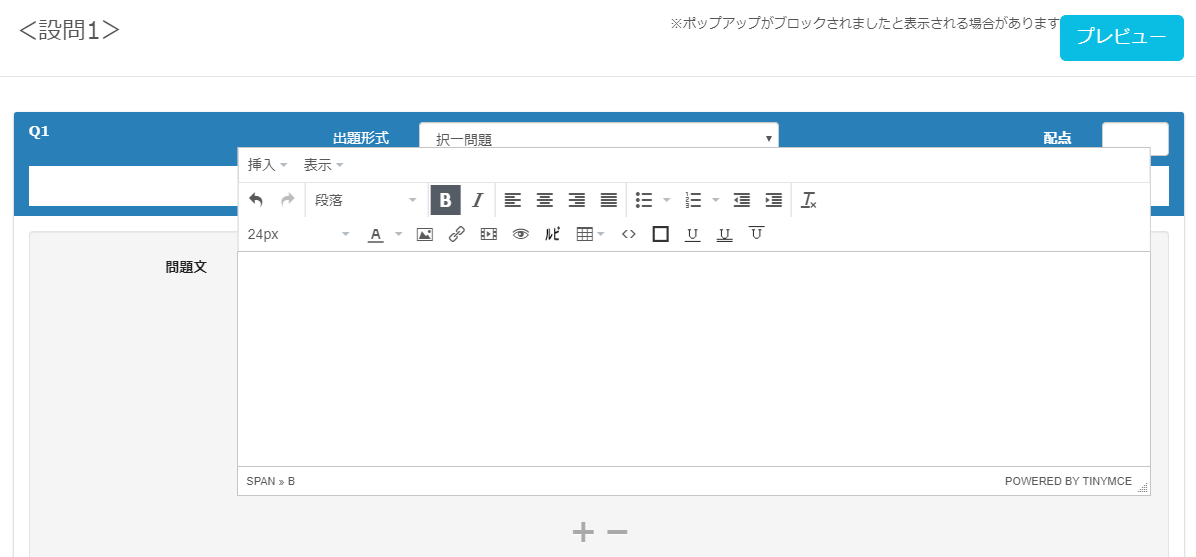
Hello, this is Nagai🎮 of the Quality Control Department, still unable to let go of my fan due to the hot and cold weather. October has arrived in the blink of an eye! In this article, I would like to share with those who want to create quizzes that can be used in e-learning, what to keep in mind when creating quizzes in the question making form and how to solve them. For those of you who are using our QuizGenerator or learningBOX and are having trouble with the questions not displaying well, how can you solve the problem? We are here to help you! If you know how to solve a small input error, you can quickly deal with it! Thank you very much for your cooperation. Click here for the Table of Contents 1. what is deceptive appearance? 2. how to solve it 3. summary What is deceived by appearance? First of all, please look at the following image. The text is typed in the "problem statement" section. At first glance, it looks like you are just typing "Don't let appearances deceive you. But if you check the actual source code, you will see ・・・・・ *This is just an example, and in some cases it can be even more complicated. Font specifications, paragraphs, headings, and many other things may be specified. ➡ " This is what I call being fooled by appearances." When do you see this kind of phenomenon? This phenomenon may occur when you use "copy and paste" which you usually use casually when creating quizzes. It is easy to create questions by copying and pasting the information you have entered in the question creation form or the text and contents posted on the Internet, but "unnecessary information such as extra line breaks, spaces, special fonts, and machine dependent characters are also incorporated when creating quizzes. Some problems occur when multiple questions are combined into one, as well as the display of the player's screen is corrupted. If a question does not display as expected, these are the most likely causes💦. Solution This is caused by using the issue creation form and you will need to check the source code for confirmation." The easiest way around this is to use text." To be precise, it is the method of using standard text. Standard text does not allow the use of html tags and only the bare text data is entered. You can adjust the text here and create questions in text format as is, or you can copy and paste it into the question creation form. You can use the standard text as you wish once you have gone through the standard text. Summary When using the question form to create a question, you may find that it appears differently than you intended. It may seem convenient, but there are unexpected pitfalls. However, html tags are there to display problems beautifully. The html tags are not that difficult to understand. Some people reject them just by looking at the English language, but I want them to touch them just a little. Furthermore, by applying HTML tags and other techniques, you can create interesting problems, such as this one. This article is a bit of advice for those who want to create quizzes that can be used in e-learning. Our e-learning system, learningBOX, has a very wide variety of quiz formats and options. Of course, we are happy to consult with you on the creation of quizzes as well. Please feel free to contact us. Thank you for taking the time to read this article.
STEM

What is STEM education?

Nice to meet you. My name is Yokoyama🐈, and I am a developer. Have you ever heard of STEM education? This is an educational model that started in the United States in the 2000s. This paper introduces STEM education, which is attracting attention around the world. Click here for Table of Contents 1. what is STEM education? 2. STEM Education Overseas 3. STEM Education in Japan 4. summary What is STEM education? STEM is an acronym for Science, Technology, Engineering, and Mathematics, and was proposed by the National Science Foundation in the 2000s. STEM education was originally initiated to increase enrollment in science and engineering fields in order to increase global competitiveness in science and technology. Today, the concept has expanded and diversified to include various related concepts, such as STEAM education with the addition of Art and STREAM education with the addition of Robotics, as creativity and sensitivity are becoming increasingly important in preparation for a super-smart society. It is not just education in science and engineering fields, Emphasis on practical skills From subject-specific education to cross-disciplinary education hands-on, creative, and proactive introduction of new technologies emphasis on integration and diversity of people: ensuring fairness of educational opportunities Emphasis on value of K-12 (K-12 elementary education) Emphasis on STEM teacher development and other initiatives are being undertaken around the world as a comprehensive education closely linked to society and creativity. STEM Education Overseas STEM education began in the U.S. and is now being actively pursued as a national policy in countries around the world. Country Name Background Specific Initiatives United States of America Government-led Promotion of IT Human Resource Development, EdTech Penetration, and STEM Education Middle-income class faces crisis amid automation by robots and AI Charter Schools Emerging to Break Away from Conventional Education Schools utilizing EdTech services such as adaptive learning, MOOCs, LMS, etc. Project-based learning-centered schools with cross-enforcement to develop soft skills (non-cognitive skills, GRIT, etc.) through a charter school system with open-ended curriculum China By 2025, China faces a severe shortage of human resources in areas critical to its future economic development Premier Li Keqiang advocates "mass entrepreneurship and universal innovation China STEM Education 2029 Innovation Action Plan Shanghai "STEM+" Education Research Center Israel Recognition that the development of scientific and technological human resources is essential for the country's continued development due to its historical/military background STEM education is introduced from an early age. In particular, science and technology kindergartens in partnership with high-tech companies allow students to learn about robotics, computers, space, and more. STEM education with special emphasis on programming and cyber security Singapore Traditionally emphasized the importance of nurturing the elite who will be at the helm of the country Particular focus on fostering human resources for key industries such as IoT, robotics, AI, biotechnology, etc. Recently introduced "humanistic education" to nurture non-cognitive skills Providing a generous, supported AI education program for young professionals to strengthen the country's AI human resource capacity Integrated program for secondary education and college preparatory education Personalization of learning and cross-disciplinary knowledge understanding and utilization through EdTech seems to be the global trend. STEM Education in Japan STEM education efforts in Japan seem to be mainly conducted by the Ministry of Internal Affairs and Communications, the Ministry of Education, Culture, Sports, Science and Technology, and the Ministry of Economy, Trade and Industry. The Ministry of Education, Culture, Sports, Science and Technology has been conducting Super Science High Schools since 2002. The MEXT aims to develop future international science and technology-related human resources, The Ministry of Education, Culture, Sports, Science and Technology (MEXT) has designated high schools that provide advanced science and mathematics education as "Super Science High Schools" in order to develop future international science and technology professionals, Development and implementation of curricula that are not based on the Courses of Study, and promotion of problem-based research, Since 2002, the program has been supporting experiential and problem-solving learning through observation and experimentation. Source: Ministry of Education, Culture, Sports, Science and Technology/Super Science High School Furthermore, various measures are being taken to fully implement programming education in elementary schools from FY2020. The Ministry of Economy, Trade and Industry (METI) has set forth three pillars for educational reform: "STEAM-ization of learning," "Independence and individual optimization of learning," and "Creation of a new learning foundation. STEAM-ization of Learning With each student's unique excitement at the core, "knowing" and "creating" will be circulated to create a learning environment that integrates the humanities and sciences. Independent and personalized learning Learning that allows students to choose how they learn based on their individual cognitive characteristics and level of achievement. Creation of a new learning foundation Learner-centered, digital-first, seamless schooling with society. In Japan, as in other countries, EdTech is being used to personalize learning, and to understand and utilize knowledge across the board. Conclusion STEM education is not only education in science and engineering fields, but also comprehensive education to "create and utilize AI and create new values" for a super-smart society. STEM education started in the U.S. and is now being actively pursued as a national policy in countries around the world. Personalization of learning and cross-cutting knowledge understanding and utilization through the use of EdTech The day may come in the not-so-distant future when e-Learning will be conducted using one computer or tablet per person as a matter of course! Our e-Learning system "learningBOX" will be developed for STEM education! 😀 😀 Click here for reference page on STEM education Source: Reference Material on the Current State of Education in Other Countries (Ministry of Economy, Trade and Industry) (used on 09/05/2019) Source: Human Resource Development for Society 5.0 - Changing Society, Changing Learning (used on 2019/09/05)

Practice typing with e-learning training!

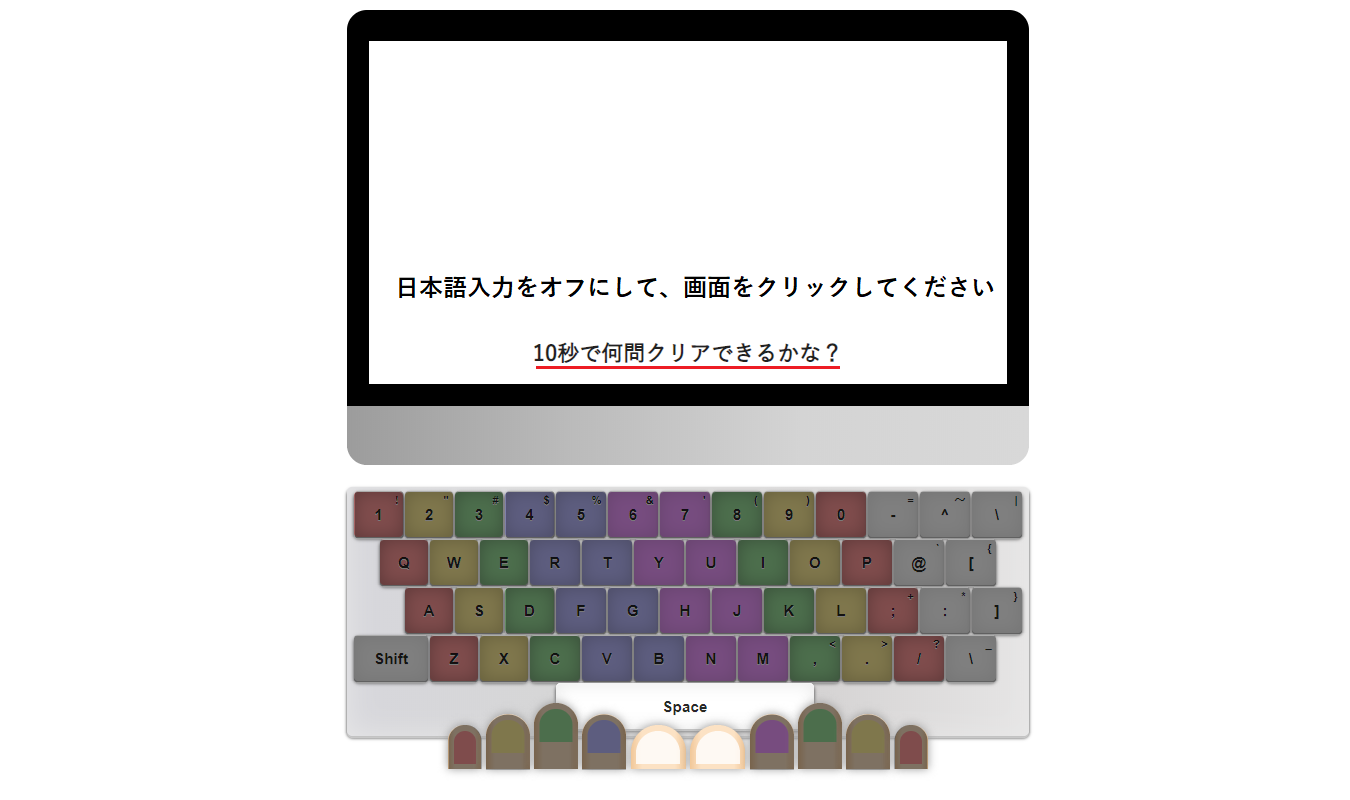
Typing Practice Now Available Through E-Learning Training! Long-sleeved cardigans are now a necessity instead of parasols. Hello! Nice to meet you, I am Kuroda from the Quality Control Department. This is my first article duty. The subject this time is "Feature Typing Materials"! Have you ever heard of "typing materials" that are included in the contents function of learningBOX? In addition to memorizing cards and creating questions, learningBOX also offers "typing materials" that allow you to practice typing as an e-learning training program. In this article, we will introduce how to create, use, and utilize "typing materials". Thank you very much for your understanding and cooperation. Table of Contents What are typing materials? 2. how to make typing materials Let's try typing text using typing materials 4. how to use it in your company 5. summary What are typing materials? Typing materials are learning contents that can be created from the content management function of learningBOX, which allows you to "input text using the keyboard. How to create typing materials Please log in to learningBOX and go to Content Management, Typing Materials ▷"Create Typing Materials". Enter the title, text, and reading style into the typing material creation form, and if there are no problems, click "Save and publish" in the upper right corner. When the form appears, follow the input boxes to set the "Text" (i.e., the question text) and "Yomikata" (i.e., the characters to be input). Hiragana, katakana, and numbers can be used for "Yomikata". Please note that Kanji, English, symbols ("", ", "), etc. cannot be used. Please note that you cannot use *For more information about the detailed settings of the typing materials, please refer to the page on how to use the typing materials. Let's try typing text using the typing materials! Good at typing! We have prepared typing materials created by our quality control. Take it to test your skills! Difficulty level The questions will be about 10 to 20 characters long. The test will be unexpected, so please be prepared for it! Passing score: 40 points How many characters can you type without typing mistakes? This is a difficult typing test that even our staff had a hard time passing! Please click on the PC monitor screen below and you will see the message "Please press the SPACE key when you are ready" and start from there! Let's typing! Please use the sample below on a PC. Not available for smartphones and tablets Thank you for your time. Now, how many points did you get for the above materials? Did you get a passing "Daruma-chan"? I created it, was it interesting? What I created was "interesting! I want to solve it again! I would be very happy if you think "It was fun! How to use within the company We distribute e-learning learning using typing materials within our company as a recreational activity. By designing courses in learningBOX, any learning material, not just typing materials, can be studied in a set order. I finally got my certificate! I worked hard every day and passed! Effectiveness and Expectations of Typing Materials I think there are many people who are not good at typing, although they don't say it out loud. They want to type quickly and accurately, but they tend to type while looking at the keyboard. They want to type quickly and accurately, but they tend to look at the keyboard while typing. I want to type quickly and accurately, but I always end up looking at the keyboard while typing.        I think everyone has his or her own problems. Advantages of improved typing Reduction in typing speed and spelling errors will reduce the amount of time spent on office work. Increased work efficiency You will be able to notice typing errors more quickly. You will be able to work with confidence as you become less computer illiterate. Typing is a seemingly simple task of "just typing on the keyboard. However, our brains accurately determine the meaning and content of words, and work in and out instantly. Keyboarding quickly and accurately based on the information processed is a more complex act than one might think. To perform this task efficiently, quickly, and accurately, daily repetitive practice is the fastest way to improve your typing. Conclusion What do you think of "typing materials" that allow you to practice typing as an e-learning training program? We hope you have been able to experience the fun of typing through hands-on experience. Although typing speed and accuracy cannot be dramatically improved in a day or two, acquiring the skill to type accurately will give you the skills you need in your company, such as improving the efficiency of your office work. Dear company training staff reading this article! If any of the following apply to you, please consider implementing learningBOX! There are too many misspellings and omissions in the text typed by employees. Recent new employees are good at using smartphones, but slow at typing on PCs. It takes time to check for errors in contract documents prepared by subordinates. Please try learningBOX for an e-learning typing practice tool that you can enjoy using your mind and body. Thank you for taking the time to read this article.
LMS Open Source

What is open source moodle for e-learning?

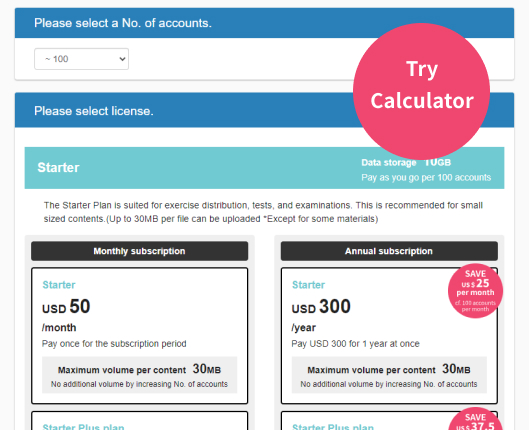
What is moodle, an open source for e-learning? Hello everyone, this is Ueda from CS. August seems to be ending in a flash, and soon it will be September. I just hope the heat will pass soon! Well, this time, I would like to talk briefly about the open source for e-learning, moodle. Before I begin, I would like to explain "open source". Open source refers to the idea that source code, which is a computer program written in a programming language that is easy for humans to understand, should be made widely available to the public so that anyone can freely handle it. It also refers to software released based on such an idea. ➡Quoted from IT Dictionary Advantages and Disadvantages of moodle There are several open source versions of LMS, but in this article, we will compare the advantages and disadvantages of moodle, which has a relatively large number of users. As for advantages, the biggest feature is that it is free of charge. Therefore, the cost at the time of introduction can be reduced. And it can be customized to any specification with a high degree of freedom. Also, based on the GPL license, users are free to download, modify, and further distribute it! One of the disadvantages of moodle is that you may not be able to secure a working environment if you use a rental server to install moodle, and if you install and operate your own server, you will need technical knowledge of servers. In addition, maintenance costs may be high in the event of problems due to the lack of a complete support system. Creating and setting up materials is also often considered difficult. Learn more about moodle eLearning - About open source moodle About our service LMS learningBOX Our service, learningBOX, is a cloud-based LMS that, unlike open source LMSs such as moodle, does not require in-house system configuration. LearningBOX is easy to use, and one of its strengths is that even those who are new to e-learning can operate it easily. 10 accounts can be used free of charge regardless of the expiration date, so you can try out almost all the functions before full-scale implementation. You can also use 11 to 100 accounts for as little as 30,000 yen per year! See more details about our pricing plans. The system is fully functional and easy to operate, including the creation and management of content, group management of members, and storage of results management. There are 12 types of contents that can be created and uploaded, including quizzes, tests, memorization cards, PDFs, videos, questionnaires, and reports. If you have any questions about implementing an LMS, we'd love to hear from you! We would be happy if you could try our free plan. Our CS team will do their best to support you before and after implementation! Conclusion What did you think? There are different types of e-learning systems. There are also many different types of e-learning systems. Each system has its own merits and demerits, and the system that best fits your needs will depend on how you operate your system. We hope this information will be helpful to those who are considering the introduction of a new system. Please find the best system for you. We are pleased to announce that we will be holding an exhibition at our booth. ▼ We will exhibit at the 3rd [Kansai] Educational IT Solution EXPO in Intex Osaka from September 25(Wed) to 27(Fri), 2019!
Find more about learningBOX