Column

The Forefront of Education] Effective Newcomer Training with Video and E-Learning

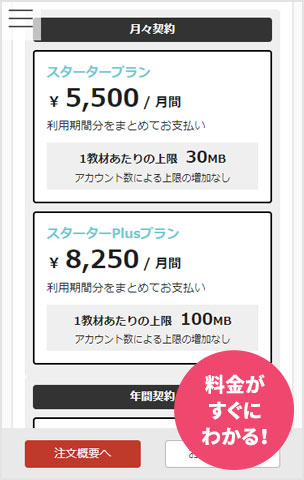
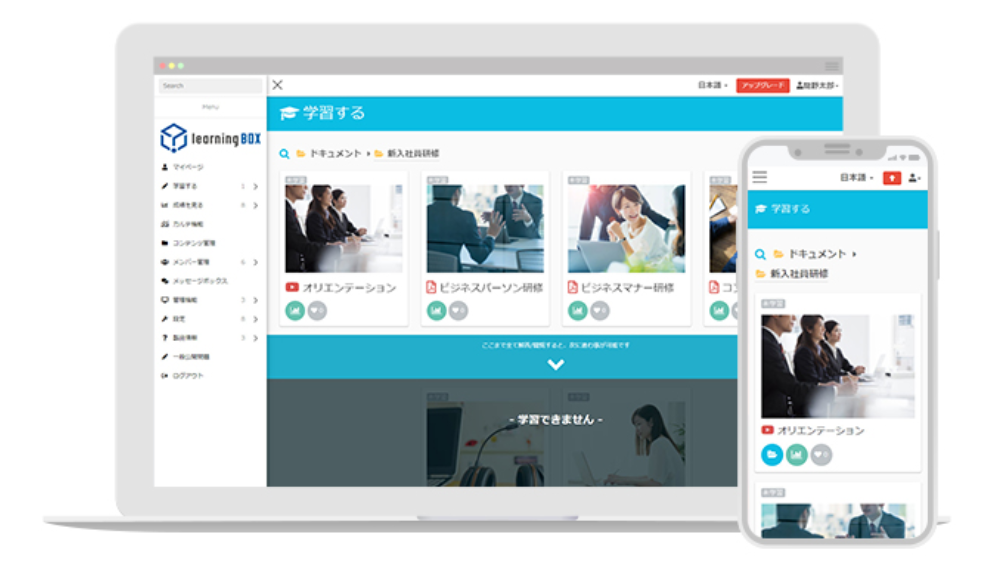
The Frontline of Education] Effective Newcomer Training with Video and E-Learning My name is Kidaoka, and I am in charge of marketing. Due to the impact of the spread of the new coronavirus, "the lifestyle of working people" in Japan has drastically changed over the past several years. In addition to the way people work, in-house education and training has also shifted from face-to-face and group training to digitalization, and efforts to "develop human resources with an eye on the after-corona" are increasing. We understand that many people in charge are wondering how to implement "management strategies, organizational development, and new skill training" to survive the Corona disaster in the future. In confronting these issues, companies must promote reforms that are in line with society and the times. In this article, we would like to introduce "human resource development utilizing video," which has recently been attracting attention and being implemented by many companies. In this article, we will explain in detail the merits of using video for human resource development and the key points for producing effective videos for training new employees. Click here for Table of Contents 1. In a word, video is informative and easy to convey! 2. Video is an effective learning tool for training new employees. 3. Combining video materials with e-learning makes it possible to visualize the course history. 4. learningBOX is an e-learning system that allows easy registration of video materials. 5. learningBOX enables smooth and stress-free learning even with large-volume videos. 6. Summary In a word, videos are informative and easy to convey! Video has the advantage that it is easily remembered by people and can be viewed by many people with the same content. Video features content that is "easy to understand, accurately conveys information, can be checked at any time, and is memorable. When we hear of traditional training and education, the easiest way to imagine it is as a class in school. At school, a teacher of each subject stands on the podium and conducts a class. However, this type of lecture-style teaching can lead to educational disparities depending on the teaching ability and quality of the teacher. On the other hand, video materials can be used to ensure a uniform level of education without being affected by the ability or physical condition of the teachers. In addition, video materials are also attracting attention as an optimal educational tool for companies that are promoting work style reform. What types of educational video formats are there? Videos used for educational videos can be broadly classified into three formats: seminar, manual, and documentary. Each of these three formats has its own unique characteristics. When shooting educational videos, it is very important to choose the format that best suits the situation in which the video will be used. Seminar format The seminar format is simply explained as "a single instructor speaking to multiple participants," like a school or university lecture. This type of video is also called "lecture style," in which a lecture-type class or training session is filmed and used as an educational video. The main point of seminar-style videos is that they are very effective for use in "newcomer training and in-house studies held periodically each year" by a company or organization. 2. Manual format Manual format videos are videos that explain the actual work flow and customer service. This type of video is effective mainly in the customer service industry, such as the restaurant and apparel industries, where the majority of work is difficult to convey through text and images alone. The point of manual-style videos is that they can be used in a variety of situations depending on the scene of utilization, such as "handling of products and services, videos that serve as instruction manuals, and videos used to help people understand the work flow of a job. The manual format is characterized by the ability to understand how to actually interact with customers through the eyes and ears, making the training easier for new employees to visualize the real situation. Documentary format Documentary-style videos are videos that show the daily lives of staff members working at the company, interviews, and scenes of them working within the company. The point of a documentary-style video is to provide "reality and storytelling. The content is like a drama, so the audience will remember it without getting bored, and by making it a narrative video, the empathy of the employees will increase. Video is an effective learning tool for training new employees. Video is an effective learning tool for training new employees, as it is more memorable and significantly more effective than text. Here are three examples of situations where videos are used: training for new recruits, compliance education, and internal operations/sales manuals. Pattern 1: Using Video for New Employee Training By using video for new employee training, in-house educators no longer need to secure a training location and instructor schedule each time a new employee joins the company. In addition, it can reduce the workload of human resources who are in charge of training new employees. When one hears the term "new employee training," the first thing that comes to mind is probably "training in business manners and basic job skills. Business manner training generally covers the minimum manners required of working adults, such as grooming, greetings, honorific expressions, and how to answer the phone. *As a point of video production, it is possible to deepen participants' understanding and impress them more by conveying the correct methods and information in areas that need to be explained in a focused manner, as well as by adding examples of mistakes. Pattern 2: Using videos for compliance education What companies want to make new employees more aware of than business manners is an understanding of the discipline to observe "laws, regulations, social norms, and ethics" related to compliance. Examples of compliance violations include "personal information leaks, accounting irregularities, overwork, and harassment. Once a problem occurs and is covered in the news as a scandal, it is subject to severe criticism from the public. By having each and every employee learn the importance of compliance and raise awareness, we can create a corporate culture that prevents compliance violations from occurring. Pattern 3: Using videos to streamline internal operations and sales manuals Video-based training is also widely used for "sales and customer service manuals. By utilizing sales and customer service manuals as training videos, it is possible to learn in an easy-to-understand and detailed manner the methods and ideas for each purpose, such as "sales and customer service methods, manners, and points for handling complaints. There are so many different ways of doing internal work and necessary skills, even in the same industry. By learning the knowledge and skills necessary to carry out work at or before joining the company, you will be able to tackle your work smoothly after being assigned to a position. In creating videos, it is necessary to make the content easy for the participants to understand, as they may not be able to look back at the manuals in the field. Combining video materials with e-learning makes it possible to visualize the course history. By utilizing an e-learning system for video materials, administrators can easily check and visualize the "learning history, learning progress, and grade information" within the system to see which videos students have watched and which they have studied. The grade data in the e-Learning System can also be downloaded in CSV format in a batch. This page introduces the advantages of using an e-Learning system to manage video materials. E-learning is a form of learning that uses the Internet! E-learning is a learning management system that allows you to "improve your skills at your own pace, unrestricted by time or place" by using electronic devices such as PCs and smartphones and the Internet. Once a learning environment has been created, e-Learning can be used over and over again. There are many advantages to using e-Learning 1. Learning can take place anywhere, anytime, at any place and at any time. 2. Students can study according to their level of understanding and learning progress without worrying about being watched. 3. Easy to grasp the performance data and grade management. 4. You can take as many preparatory, review, and re-study courses as you like. For more information on the features and structure of e-learning, please refer to this article. Combining video materials and e-Learning can realize high-quality education and training for all employees By importing videos taken by the customer into the e-Learning system, participants are freed from the constraints of location, time, and instructor labor costs. In addition, since participants can attend lectures at their own pace, anytime, anywhere, employee satisfaction is increased, and the system becomes a tool for promoting work style reforms. *This system is not limited to urban or rural areas, and can be used to provide education to anyone and develop human resources. learningBOX is an e-learning system that allows you to easily register video materials learningBOX is an e-learning system that makes it easy for anyone, from individuals to companies, to start e-learning. It is the ideal learning management system for customers who wish to conduct in-house training with videos. LearningBOX is simple to use and easy to operate! This learning management system provides all the functions necessary for e-learning, including the creation and distribution of teaching materials, grade management, and student management, making it "easy for anyone to build a web-based learning environment. LearningBOX is so easy to use that there is no need to read the manual. Video registration is as easy as clicking the "plus" button! When registering videos, you can freely set the limit on the number of lessons and skip playback [enable/disable] of videos according to your preferences. LearningBOX also makes it easy to register YouTube videos that have been posted on YouTube, in addition to videos taken by the customer. Students enter their ID and password and click the [Learn] button to proceed with the course. Using the learningBOX contents function, it is easy to check the level of understanding of videos. Between you and us, learningBOX offers many other learning tools necessary for training newcomers, in addition to videos. LearningBOX is an e-learning system that allows you to set various conditions within the system. For more information on the contents that can be set up on learningBOX, please refer to this official page. ⇒ official page of learningBOX With learningBOX, you can take lessons smoothly and stress-free, even with large-volume videos! When a video is playing, there are no advertisements, so you can concentrate on learning. The administrator can keep track of the exact playback time of each student and confirm whether or not he/she has watched the video all the way through. LearningBOX uses Amazon Web Services' Cloud Front for video delivery. The Standard Plan is a cost-effective plan that also allows for the use of video! Standard Plan The Standard Plan is suitable for video education, allowing uploading of up to 500 MB per file. This plan is perfect for customers who are looking to start up "training and video education. The Premium Plan is recommended for those who want to enhance their video-centered video learning! The Premium Plan allows you to upload a larger amount of video than the Starter and Standard Plans. You can deliver "high quality videos" according to your line conditions and device performance. The Premium Plan is suitable for those who want to deliver high quality and large-volume videos. Large-volume videos can be delivered with optimal quality according to line conditions and device performance. Educational materials up to 5 GB per file can be uploaded. Conclusion In this article, we have introduced "video-based" human resource development, which has recently been the focus of attention at many companies. Recently, the widespread use of smartphones and other devices has made it easier for people to view videos. As a result, in recent years, the "learn by video" style of corporate education has become widespread, and the video market is growing rapidly. Our learningBOX is an e-learning system that can be easily set up even by first-time users. In addition to a wide variety of teaching materials, learningBOX allows users to easily create and upload learning materials. In addition, learningBOX offers a free plan that allows you to use the system for an unlimited period of time. This plan allows up to 10 users, including the administrator, to use almost all of the features for free, with the exception of optional features that require a fee. Please take this opportunity to try our learningBOX.

What is microlearning content? Explaining the types and how to create them

What is Microlearning Content? Explaining the types and how to create them. Some people may want to implement microlearning but are not sure what kind of content to create. Since microlearning is a learning method that can be utilized in the time available, if you do not know how to create contents, you will not see the results you expect. In this article, we will discuss examples of microlearning content and tips on how to create it in detail. Table of Contents 1. What is Microlearning? 2. examples of microlearning content 3. how to create microlearning content 4. summary What is Microlearning? Microlearning is a method that specializes in learning in a short period of time and is more suited for studying relatively simple content compared to e-learning. There are no restrictions on the method, such as videos or articles. In the case of microlearning, the content can be 1 to 10 minutes at a time. It is a method that allows you to study in your spare time, such as during your commute or breaks. Microlearning has spread as a new type of learning because the way people learn has changed to suit their lifestyles in line with the diversification of work styles, such as teleworking and shorter working hours. Examples of microlearning content Let's take a look at what is included in microlearning content. Microlearning content should be characterized as "simple content that can be learned by watching and listening to it repeatedly. It is not suitable for difficult learning content or learning content that is learned through communication. Video Micro-learning can be achieved by having students watch short videos. A few minutes of video viewing will create an easy learning opportunity. You can enhance the learning effect by repeating the process many times. Audio Content with audio can be used for "learning while doing things," such as while commuting to work or doing household chores. This is especially useful when the timing for listening is limited. Textbooks Textbooks that can be read in a short period of time can be used for easy study anywhere, such as on the train or in the bath. It is ideal for learning vocabulary, for example. Quiz format There are quiz formats such as multiple-choice and 0x questions that can be completed within a few minutes. You will be able to study while having fun. You can also repeat the questions you got wrong. How to create microlearning content In order to help students learn more in less time, we will focus on how to create content, which is different from e-learning. Number of contents is important For microlearning, the number of content is important. Because the learning must be completed quickly, it is likely that a small number of content pieces will not cover the entire learning area. You need to expose them to a lot of content so that they learn a variety of information. Difficult content is not suitable Microlearning is not suitable for complex and difficult content. For example, if the subject matter requires long-winded descriptions or difficult calculations, they will not be able to learn it. The content should be simple and easy to understand. Use a service that makes it easy to create In order to create a large number of contents and have them viewed by learners, it is important to use a service that makes it easy to create contents. If it is difficult to create and distribute content, it will increase the burden on both the teacher and the student. The use of a service that can be easily created and distributed, and easily accessed by learners, is appropriate. Conclusion Microlearning is an easy way to learn in less than 1-10 minutes. It is suitable for learners who want to acquire knowledge through repeated viewing of content that is relatively easy to learn. On the other hand, it is not suitable for difficult content or content that requires interpersonal skills that cannot be covered by microlearning. LearningBOX" offers a wide variety of learning material formats, and its various question creation systems can solve the problems of content creation and delivery on the teaching side. In addition, its intuitive design makes it easy for the learner to use, which leads to less stress during the learning process and more effective learning. Let's try to incorporate microlearning while understanding the characteristics of the content. Also recommended! Also read "The hottest education trend right now! Micro-Learning Transforms Human Resource Education"

CSV and Character Encoding - Avoid Character Garbling with utf8 with BOM

This is Mr. Nishimura, Representative Director! It's been a while since I've written a blog, but I've added a BOM to prevent garbled text in Excel. learningBOX is an LMS with multilingual support Our e-learning system, learningBOX, is a multilingual LMS. learningBOX's UI is currently only available in Japanese and English, but the data and learner answers are flexible enough to support not only Japanese and English, but also Chinese, Korean, Vietnamese, and other languages around the world. However, the data for teaching materials and learner answers are available not only in English and Japanese, but also in Chinese, Korean, Vietnamese, and other languages around the world. In fact, training materials created in various languages are being used in training programs for foreigners. CSV multilingual support was incomplete. In spite of the claim of multilingual support, there was a deficiency in the CSV support. In the currently released version (2.14.28), CSV encoding is fixed to Shift_JIS (Windows-31J). As a result, all characters except Japanese, English, and some Chinese and Latin characters are garbled. Back to Table of Contents UTF-8 is implemented to be able to select UTF-8 There was a proposal to switch the character encoding of CSV output from learningBOX to UTF-8, but we decided that a sudden change in the specification would have a large impact on users, so we made it possible to choose between UTF-8 and Shift_JIS for the character encoding of CSV. (Default is Shift_JIS) Back to Table of Contents BOM is added to prevent garbled characters in Excel If you open a UTF-8 CSV without BOM in Excel, the characters will be garbled.BOM stands for "Byte Order Mark" and indicates that the character code of the file is "UTF-8". Therefore, by using UTF-8 with BOM, the file can be opened in Excel without garbled characters. A decade ago, it was common to avoid garbled characters by creating files in UTF-16LE, but relatively recent Excel is now fine with utf8 with BOM. Also, considering that the character encoding in the Web world is becoming unified to utf8 and that it is easier to handle outside of Excel, we decided to use utf8 instead of UTF-16LE. Reference site: How to output Unicode csv files that can be opened correctly in both Win and Mac Excel Back to Table of Contents How to add BOM in PHP The entity of the BOM is 3 bytes of data and is expressed as "\xEF\xBB\xBF\xBF". In the case of PHP, the BOM can be attached by doing the following. $csv = "\xEF\xBB\xBF".$csv; Back to Table of Contents Scheduled Release Depending on the results of the verification, we expect to release the product in the next week or the week after next. Back to Table of Contents learningBOX developer wanted! We are looking for learningBOX developers. We have various openings for backend engineers, frontend engineers, quality assurance engineers, and project managers. We are looking for development engineers mainly at our headquarters in Tatsu, but we are also actively recruiting infrastructure engineers in Tokyo, so please apply if you are interested, However, if you have experience in Linux operation or have studied Linux or networking at an infrastructure school, you may be welcome to apply! Back to Table of Contents
What are the advantages of e-learning? Explained along with the disadvantages

What are the advantages of e-learning? Explained along with the disadvantages

What are the advantages of e-learning? Explained along with disadvantages. Many people have experience using e-learning for learning. However, some of you may not be aware of the advantages and disadvantages of implementing e-learning in your company. In this article, we will take a closer look at the advantages and disadvantages of e-learning. Click here for the Table of Contents 1. What is e-Learning? 2. merits of e-learning 3. disadvantages of e-learning 4. summary What is e-Learning? E-learning is a learning method that utilizes a learning management system called LMS. It can be used at home, on the way to work, or at any other free time with a smartphone, tablet, or computer. For example, it is often used for language or qualification acquisition. Advantages of e-Learning Let's take a look at the benefits of e-Learning from the perspective of a company that wants to introduce e-Learning. Please take a look at them from the perspective of a company that wants to introduce e-learning, especially if you plan to introduce e-learning in your company in the future. Reduced costs E-learning can reduce costs. For example, if you hold a training session with a large number of learners, you may incur the following costs 1. venue costs 2. transportation costs for participants 3. printing and transportation costs for teaching materials In contrast, e-learning can reduce the above costs. Another advantage is that it is easier to manage. No need to gather all participants in one place. In recent years, due to the new coronavirus, the act of gathering a large number of people is risky. With e-learning, there is no need to gather learners in the same place. Each can continue learning in an environment where they are comfortable studying. Easy to manage grades An LMS that can deliver learning materials through e-learning is a system that not only delivers learning materials, but also makes it easy to manage grades. This makes it easy for the distributor to keep track of the situation. In addition, it is possible to manage various aspects, such as learner grades and understanding of areas of weakness. Free Review Opportunities E-learning courses can be viewed over and over again at any time. This makes it possible to instruct students to repeatedly review areas of weakness that they have not been able to grasp in a single session. Disadvantages of e-Learning E-learning also has disadvantages. Consider introducing e-learning after understanding them. A certain level of knowledge is required for implementation and production. A certain level of knowledge is required to introduce e-learning and to produce learning materials. For example, you may not know how to use the LMS required for e-learning or how to create questions for the first time. In such cases, consider using a "creation system service" that provides introduction support and question production on your behalf. Internet access is required for students An Internet environment is essential for e-learning. A smartphone, tablet, or computer is required. In addition, if you do not have an Internet environment capable of viewing large videos, it is unlikely to be a suitable learning environment. If you do not have an Internet environment, you should consider whether your company can support it. Q&A and other interactions are difficult. E-learning has the disadvantage of not allowing direct interaction with the instructor. Therefore, there is a possibility that support cannot be provided adequately because there is no time for questions and answers on topics that are not understood. As a countermeasure, it is necessary to set up a support system before introducing e-learning, for example, by providing opportunities for learners to ask questions about what they are not good at or what they do not understand. Conclusion E-learning has advantages such as cost reduction, flexible learning style, and easy grade management. On the other hand, it is important to consider the introduction of e-learning with an understanding of its disadvantages. If you find it difficult to introduce e-learning, there are alternatives such as receiving support from a creation system service. LearningBOX" has a support system that covers the entire process from introduction to use of e-learning in corporate training, certification examinations, and distance learning, so you can use it with confidence even if you have no knowledge of creating learning materials. The system is designed to be intuitive and easy to use, and it offers a variety of learning material formats to reduce stress during the learning process and make learning more effective. Please give it a try. Also recommended! Read also "E-learning will dramatically change the way you work! What are the advantages and disadvantages of e-learning?
What is e-learning?

What is e-learning? Explaining learning materials and what you need

What is e-learning? Learning materials and what you need are explained. Some of you may be thinking about introducing e-learning as a new learning method, but may not know exactly how to go about it. In this article, we will provide an overview of e-learning and the actual learning materials. Please refer to it to maximize the learning effect. Click here for Table of Contents 1. What is e-Learning? 2. e-Learning Learning Materials 3. 3 Things You Need for E-Learning 4. summary What is e-Learning? E-learning is an Internet-based learning system. With a smartphone, computer, or tablet, learners can study regardless of time and place. In recent years, the new coronavirus has made it difficult for many people to gather together to study. However, with e-learning, learners can study at home or on the go, thus reducing the risk of infection among learners to some extent. E-learning study materials E-learning offers a wide variety of content and learning materials. In addition, courses can be set up for different levels, making it possible to create a learning plan that suits each individual student. Let's take a look at some specific examples. Video Delivery Learn from instructor-led courses via video. The recorded videos can be viewed repeatedly, making them ideal for learners to review. There is no limit to the delivery time, and videos of one to two hours in length can be delivered. Learners can study at their own pace, which is attractive. Quiz This is a pattern in which learning proceeds in the form of various quizzes, such as multiple-choice questions and 0x questions. It is possible to create content that learners can enjoy while learning. Web page This is a teaching material that uses web pages for learning through images and text. Video and audio can be incorporated into the web pages. Memorization cards Memorization cards are used to memorize important vocabulary. They will help you learn more efficiently because you can easily distinguish words you have memorized from those you have difficulty with. Worm-eaten notebooks Mushi-Eyed Notebooks, in which words in sentences are hidden, are mainly used as memorization aids. The percentage of correct answers to questions is immediately displayed, making it easy to repeat exercises. Report Assignments E-learning also offers a system for submitting report assignments. The system can be adapted to the will of the submitter by using a web form or sending data by e-mail. PDF materials Materials such as Excel and PowerPoint can be distributed to students as PDF materials. PDF materials can be used not only on PCs, but also on smartphones and tablets, making them suitable for learning while commuting to and from school. Tests E-learning allows for easy configuration of test formats, such as fill-in-the-blanks and essay tests. Administrators can also manage grades and other information on the e-Learning system, which helps them tailor the learning content to each student. Three things you need for e-Learning There are three things you need to implement eLearning. All three are essential for smooth interaction between learners and instructors, so be sure to check them before implementing e-learning. LMS (Learning Management System) LMS (Learning Management System) is called a learning management system in Japanese. It is the foundation for delivering e-learning learning materials. When an LMS is used, not only is it easy to distribute learning materials, but it is also easy to understand the learning status of learners. Teaching Materials Learning materials are necessary to deliver e-Learning. Materials can be created on the LMS and uploaded to the LMS for distribution to learners. Smartphones, tablets, and PCs Learners can use their smartphones, tablets, or PCs to study. The service provider may provide dedicated equipment. However, it is important to note that even if the equipment is available, the LMS cannot be accessed without a network environment. Conclusion E-learning is a system that allows learners to study at home or on the road regardless of time. If utilized properly, learners can enjoy learning at their own pace. Another advantage is that it is easy for the instructor to monitor the learner's progress. Learning BOX" takes advantage of the benefits of e-learning and offers a wide variety of learning material formats, and its extensive question creation system solves the problems that instructors face in creating and distributing content. In addition, its intuitive design makes it easy to use for the learner, which leads to less stress during learning and more effective learning. Let's make the most of e-learning to help learners learn. Also recommended! Also read "A Thorough Explanation of the Basics of E-Learning, How It Works, and How to Use It" [2020-2021].
E-learning - free

Important】Information about the change of CSV format

LearningBOX was upgraded from version 2.13 to 2.14 on May 12, 2021. With this major update, some of the CSV formats for member management have been changed. Due to the format changes, an error message will appear and registration will not be possible when uploading using the format you used in the 2.13 series. This article introduces the CSV format changed from 2.13 series to 2.14 series and how to improve it. Click here for the Table of Contents 1. CSV format (2.13 series) 2. CSV format (2.14 series) 3. Points to note when uploading members in batches 4. Apology for format change CSV format of 2.13 series Prior to the 2.13 series, the format had a total of 10 items from left to right: login ID, name, display name, department, title, e-mail address, password, status, number of days valid, and group affiliation. CSV format in 2.14 series In the 2.14 series and later, the format items have been changed to 11 items in order from left to right: login ID, name, e-mail address, password, country of residence, language, time zone, status, deadline type, number of valid days/date, and group affiliation, and the order and item names have been changed. Notes on uploading members in batches If you register members using the pre-2.13 format, an error message will appear as shown below and you will not be able to register members. An error message is displayed when you perform the upload and click Proceed to Confirmation Screen. We apologize for any inconvenience this may cause you, but please click the Plus button on the Member Management screen, go to [Batch Operation (CSV)] >> [Member Registration/Update], download the [Sample CSV Format], enter your member information again, and upload the file. Then, fill in the member information again and upload the file. Open the downloaded file and enter member information. Finally, upload the files and you are done. How to upload using an existing CSV file Open your CSV file. Edit the CSV file, edit the order according to the 2.14 series format, and add items. Enter the member information used in the existing CSV. Overwrite and save the edited CSV file and upload the file. Apology for Format Change On May 12, 2021, learningBOX was upgraded from version 2.13 to 2.14. With this major update, the format of CSV for member management has been partially changed. We sincerely apologize for the lack of information sharing within our company in connection with the change in functionality, and for the fact that we released the product without notifying our customers. In the future, we will closely communicate and coordinate within our team to ensure that we do not repeat the same mistake. We sincerely apologize to our customers, business partners, and all other concerned parties for any inconvenience and trouble this may have caused. We look forward to your continued support in the future.
elearning-platform

[Latest in 2021] An in-depth look at e-learning platforms

[Latest Edition for 2021] In-Depth Explanation of e-Learning Platforms This is Kidaoka, Marketing Manager. The new coronavirus infection is spreading around the world, and the "fourth wave" in Japan is spreading much faster than previous levels. Many companies around the world have made rapid progress in "reviewing and streamlining their operations through the introduction and use of IT technology" as a countermeasure against infection. In Japan, many companies and educational institutions are also accelerating their moves toward the introduction of e-learning. In this article, we would like to introduce e-learning to those who would like to start e-learning! This article will provide detailed information on how e-learning works and how to use it for customers who want to introduce e-learning in their companies. We hope you will find this article useful. Click here for the Table of Contents 1. What exactly is e-Learning? 2. Learning Management Systems Supporting the e-Learning Structure 3. Points to keep in mind when selecting an e-Learning platform 4. Introducing the use scenarios of LMS 5. learningBOX is an LMS that allows you to start e-learning for free! 6. Summary What exactly is e-learning? To briefly explain e-Learning, it is "a learning method using computers and the Internet. Unlike the face-to-face learning received in traditional schools, e-learning is characterized by a learning system that allows interactive communication between learners and administrators using mobile devices such as "computers, tablets, and smart phones. Recent innovative developments in IT technology have made it possible for individuals to start e-learning easily. By using a dedicated platform, "anyone can easily start e-learning in-house" without having to build a system from scratch. A platform is a standard environment that serves as a common foundation for providing, customizing, and operating services, systems, and software.  Background of e-Learning's Attention Computer-aided learning (CAI), which is the basis of e-learning, was developed in the 1950s, mainly in the U.S., based on the idea of "Can't computers support education? The development of e-learning began in the 1950s, mainly in the United States, based on an idea called CAI, "Can't computers support education? Before the Internet became widespread, video-based learning was the mainstream. Video-based learning was considered more effective than text-only reference books. However, there are some disadvantages: "You can only take a class at a fixed time, and you can only take a class if you gather in one place. In conventional group or in-house training, the instructor and trainees have to be in the same place for a long time, and the manager has to check the progress of the trainees, which is not what we would call efficient. This is why e-learning has attracted attention because of its many advantages, such as the fact that it does not require any time or place for learning, reduces costs, and allows for learner management. The history of e-learning is explained in detail in this article.  E-learning is a learning tool that can effectively support human resource education The introduction of remote work in Japan has increased due to the impact of the new coronavirus, but at the same time, it has also brought to light the challenges of human resource evaluation and management. Many people are interested in using e-Learning as a "purpose to solve human resource education issues, such as improving the efficiency of in-house training and fairness of personnel evaluations. In the midst of the Corona disaster, the entire world has developed a tendency to avoid meeting with people, making it difficult to conduct business and education that used to depend on meeting with people. In order to overcome this situation, the use of e-learning and corporate initiatives for DX played an indispensable role. *DX is a term for "digital transformation," meaning the use of IT information technology to change people's lives for the better. Purpose and Aim of E-Learning (on the participant's side) 1. to learn to improve their skills and career 2. to acquire knowledge and skills that are useful in their work 3. To study without time or location restrictions 4. to review at their own convenience Purpose and Aim of E-Learning (Personnel side) 1. To create an environment for busy employees to learn anytime, anywhere. 2. To provide thorough training on compliance that should be followed as a company 3. To establish an online training program that thoroughly covers infectious disease prevention. 4. To reduce training costs. Features of e-Learning E-learning has its advantages and disadvantages, but what you may be interested in is its performance after it is actually introduced. In order to effectively demonstrate the benefits of e-learning, it is of utmost importance to ensure that the training is well implemented within the company. When considering the introduction of e-Learning for "training, certification, and human resources education," understanding the advantages and disadvantages will help ensure smooth progress during the introduction and operation of the system. The functions of e-Learning can be briefly summarized as follows Training can be conducted by making effective use of time. Cost reductions can be expected. Centralized management of employee learning status and performance information This article provides a detailed explanation of the advantages and disadvantages of e-learning for a variety of customer use scenarios. Learning Management Systems Supporting e-Learning Structure The most common way to use e-Learning is through a system on the Internet. In the past, most e-Learning was in the form of reading a CD-ROM or DVD-ROM on a computer to start learning, but now it is possible to log in to the system on the Internet and proceed with learning easily. In addition, with the advent of learning management systems (LMS) for managing e-learning, it is now possible to integrate and centrally manage content registration, delivery, and grade data necessary to implement e-learning.  The Role of a Learning Management System (LMS) LMS stands for "Learning Management System. LMS refers to a platform for managing and operating human resource education on a system via the Internet and computers. With the advent of the LMS platform, a system is in place for integrated management of information necessary for e-learning operations, allowing "learners to check their own learning history and test results, and receive support and feedback at the most appropriate time. LMS is mainly used as a training system for companies, and in some cases, it is used as a complementary system to facilitate interactive communication between instructors and students. In other cases, LMSs are being used for "talent management," which is the systematic development of human resources according to the aptitude of employees and the company's human resources goals. *Talent management is a concept aimed at strategic personnel allocation and human resource development by centrally managing and operating data on talent, skills, and experience, which represent the abilities, qualities, and talents of employees.  Main Functions of LMS The structure of an LMS can be broadly divided into "e-learning functions and management functions. By implementing an LMS, administrators can easily check the progress of learners and their learning outcomes using numerical values and graphs. LMS Function #1: Management of Course Materials Some LMS functions only allow the use of educational materials that have been pre-registered by the operator. A system that allows users to register their own content or create content within the system may be called an "LCMS" among LMSs. LMS Function #2: Distributing Learning Materials All learning materials for e-learning are stored in the LMS, and the materials stored in the LMS are distributed to students' devices via the Internet. There are "functions to do 00" such as playing videos, learning content, and administering exams, and these functions are always present in any LMS, but the type and content of content that can be handled depends on the LMS you are using. LMS Function 3: Managing Accounts Allow users to register themselves The administrator registers each user one by one. The administrator registers all accounts by CSV file. ・Administrator registers users one by one by CSV LMS Function #4: Managing Grades The LMS records all of the learner's progress. Therefore, even if there are many learners in a large company, the learning status can be centrally managed, and learners can be managed and analyzed in various segments. Points to keep in mind when selecting an e-learning platform Platform means "an underlying environment or place," and is used in business terms to mean "a place or system that provides multiple services or products. An e-Learning platform refers to a learning system that provides various e-Learning contents on the platform. On the platform, detailed settings such as content assignment, management of student information and learning progress, and viewing of learning data are possible. Three important points to consider when choosing an e-learning platform When selecting an e-learning platform, we refer to e-learning functions, implementation effectiveness, case studies of actual implementations, support details, and cost (price). In addition, why not also refer to the other three points we are about to introduce? Choose a service from a long-term perspective When selecting an e-Learning/LMS service, proceed in light of your company's current situation and challenges. While selecting a system that fits your current situation, there is no guarantee that your needs will not change in the future. A mid- to long-term perspective is also very important. Who is going to use e-learning? In order to utilize e-learning and LMS services in an optimal manner to address your company's issues, you need to develop an education plan that is optimized to meet the objectives of who (which department) will be in charge, on what themes, and for whom e-learning will be utilized. Consider ease of use for employees taking the course. When implementing an e-learning/LMS service, HR personnel should be careful not to think about the functions and usability from the perspective of the person in charge of the course, rather than from the perspective of the employees who will be taking the course. It is necessary to examine usability from the user's perspective, taking into account the need for employees to learn how to operate and set up the system, as well as the need for on-site training staff to learn how to operate and set up some of the functions. Here are some examples of LMS use Advances in LMSs have made it possible to quickly and flexibly handle course registration, course participant management, and updating of course materials. Here we introduce an example of "in-house training and certification examinations," which is a possible usage scenario for our customers. Customers considering using e-Learning for in-house training Once a learning environment has been created, e-learning can be used over and over again. Therefore, it has the potential to significantly reduce the cost of in-house group training and training for new employees. The following costs are incurred when conducting group training Transportation costs incurred when gathering participants at the venue. 2. venue costs incurred in conducting the training Printing and distribution costs for training materials By conducting training via e-learning, you can reduce the time and costs associated with venue expenses and course textbook distribution. E-learning can provide flexible learning opportunities for those with irregular working hours or mid-career hires who would otherwise be difficult to accommodate in a group training program. Customers considering use in certification examinations E-learning learning data can be easily exported from the LMS, the delivery system. Thus, it is possible to easily check the data necessary for learning management, such as learning progress (not yet/not yet/completed, etc.), time of implementation, time required, test scores, etc., and to download grade data in a batch. Accumulated grade data can also be converted into numerical values and displayed in graph form. ▼ Advantages of the certification test 1. You can study anytime and anywhere at your own convenience. 2. Study can be advanced according to one's level of understanding and learning progress. 3. Easy to grasp performance data and grade management E-learning is a very suitable learning method for qualification acquisition, preparation for examinations, and overcoming weak subjects, because you can study at your own pace and repeat your studies as many times as you like. learningBOX is an LMS that allows you to start e-learning for free! learningBOX", Tatsuno Information System's LMS (Learning Management System), is designed not from the developer's perspective, but from the user's perspective. learningBOX is an e-learning "box" that enables the construction and management of a conventional learning environment on the web. Inside this box, learning materials such as videos and PDFs, questions and tests, and grades are stored, and the system manages the learning process. If you have any of these problems, learningBOX can solve them! 1. You already have an LMS (Learning Management System) in place, but you find it difficult to operate, set up, and understand the system. 2. You have a problem that only a person with IT knowledge can set up and manage the system. 3. I want to reduce the cost of the LMS. Please feel free to contact us if you have any questions or concerns about e-learning implementation. Online meetings for introduction support are also available.  learningBOX is an easy-to-use LMS that allows anyone to easily create teaching materials Using the quiz function of learningBOX, you can create web tests and web quizzes with more than 13 different types of questions, including multiple-choice, multiple-answer, essay, and fill-in-the-blank. In addition to the quiz function, you can also register and create PDF materials, video materials, report assignments, and typing materials as contents. Anyone can easily create educational materials by simply entering and selecting questions in the question creation form, and the system can be operated intuitively with no programming knowledge required. Web tests can also be created in Excel or text format, and even large numbers of questions can be registered in a batch. Learning course creation function for systematic human resource training Learning courses can be created along with teaching materials, and the order of learning can be controlled. The number of courses can be limited, time limits can be set, and questions and options can be randomized, making it ideal for employee training, examinations, and correspondence courses. LearningBOX is 1/10 of the industry price! LearningBOX allows 100 students to start e-learning for as little as 33,000 yen per year! The biggest advantage of our e-learning system is that it is the cheapest in the industry. The Starter Plan is available for 100 people for as low as 33,000 yen per year, or 2,750 yen per month (tax included). We also offer a free plan that can be used for an unlimited period of time. This plan allows up to 10 users, including the administrator, to use almost all features for free, with the exception of optional features that require a fee. EC function allows you to sell learning contents! By using the EC function of learningBOX, you can sell learning contents on the web. It is also compatible with credit card recurring billing and invoice payment. Introducing some examples of actual use of the learningBOX What has changed since we started using learningBOX? Improvements have been made! We have collected some of the happy voices after the introduction of learningBOX, such as "learningBOX has changed here! Please click here to see a list of learningBOX case studies. Japan Art Examination Association Disaster Response Training Center, The University of Tokyo Conclusion In this article, we have introduced how e-learning works and how to use it to those who want to start e-learning! This article has introduced the structure and usage of e-learning to customers who are interested in introducing e-learning in their companies. LearningBOX also offers a free plan that can be used for an unlimited period of time. This plan allows up to 10 users, including the administrator, to use almost all functions for free, with the exception of optional features that require a fee. Please take this opportunity to try our learningBOX. Thank you for taking the time to read this article. For more information on how to use learningBOX, please visit the official page here. ➡learningBOX official page
learningBOX-2.14-version up

LearningBOX is upgraded to Ver2.14.

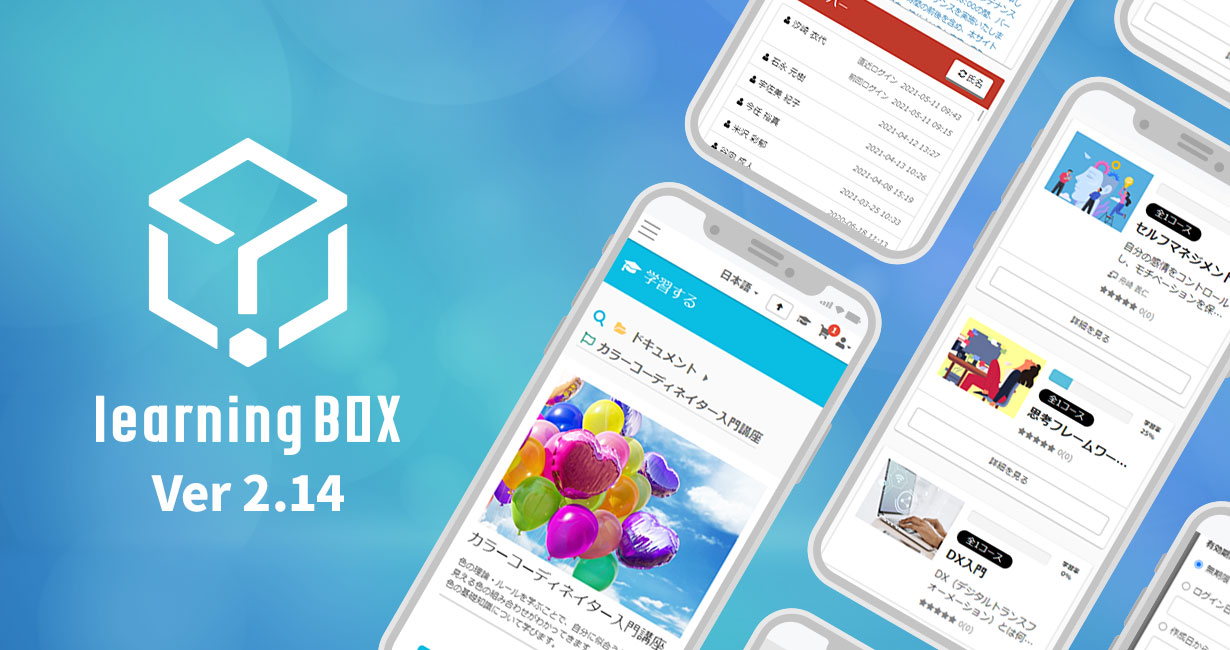
About this Version Upgrade Thank you for using learningBOX, our e-learning creation system. Today, learningBOX has been upgraded from Ver. 2.13 to Ver. 2.14. This article provides details about Ver. 2.14.22 (released on May 12, 2021), to which various new features have been added. Click here for a list of new features and functional improvements. New Functions Functional Improvements 1. new pricing plan (Premium Plan) 5. folder shortcut function 2. Security-related functions 6. 3. Curriculum functions 7. Dashboard functions 4. Course function In this upgrade, we have developed new "security-related features" that have been requested for some time. In addition, a new pricing plan "Premium Plan" will be launched. In addition, many other features have been added, including improvements to existing features. We will now introduce the details of the 2.14 series version upgrade. New pricing plan (Premium Plan) A new pricing plan, the Premium Plan, has been added. With the Premium Plan, you can upload larger amounts of video than with the Starter and Standard Plans. High-quality videos" can be delivered according to line conditions and device performance. Security-related features The security features of learningBOX have been greatly enhanced, including account expiration date settings, enhanced password functions, and password re-entry for important processes. Curriculum Functions A curriculum function has been added. This feature allows learners to learn efficiently/planningly. Curriculum function is available only for customers who subscribe to a shared server/customized design or a dedicated server. Course Function A new course function has been added. This allows the administrator to set up favorite courses for learners or courses in a desired order of study. Folder Shortcuts A folder shortcut feature has been added. Folders added with linked folders will be displayed in a slightly darker color. Function to change the page immediately after login You can freely set the page to be accessed immediately after login. Dashboard Function A dashboard function has been added. This function allows you to display educational materials created by the Curriculum/Course function according to rules determined by the administrator. Miscellaneous For further details or questions, please contact our CS Sales Team. Inquiry Form We will continue to listen to our customers' voices and improve our functions to make your use of our products even more comfortable. Thank you for your continued support of LearningBOX/QuizGenerator.
Digital textbooks to start soon

[Full-scale introduction in 2024] Thorough explanation of the digital textbooks that will start soon!

Full-scale introduction in 2024] An in-depth look at digital textbooks now, which will begin soon! My name is Kidaoka, and I am in charge of marketing. I find myself entering my third year of life in Hyogo Prefecture! With the start of the new fiscal year, our company has gained yet another new member and is becoming more and more active. To all the new members, let's make the company exciting together from now on! Putting aside the chit-chat, I'd like to get right into the contents of this issue. For those of you who work in the school industry! Digital textbooks will be available in the near future. The Ministry of Education, Culture, Sports, Science and Technology is steadily preparing for the introduction of digital textbooks by the year 2024. In this article, we will introduce digital textbooks, which are likely to become a pillar of education in the future. We hope you will continue to read this article with us. Click here for Table of Contents 1. The "age of digital textbooks" is coming. 2. Advantages of Introducing Digital Textbooks 3. ICT Education in Japan toward the Realization of Digital Textbooks 4. Changing School Education with "IT" x "Education"! 5. Conclusion The "age of digital textbooks" is coming! Digital textbooks, whose introduction was institutionalized in April 2019, are electronic learning materials that are recorded directly from paper textbooks. Digital textbooks are literally learning materials designed for digital devices and information terminals such as PCs, tablets, and smartphones. Although most people have the impression that they are digital versions of books and reference books that have been used in the classroom, digital textbooks are convenient textbooks that allow students to edit and write in the textbook and connect to the Internet. According to the Ministry of Education, Culture, Sports, Science and Technology, digital textbooks are proposed as follows Digital textbooks are defined as "electromagnetic records that contain the entire content of a paper textbook." This is defined as Quote: Institutionalization of Digital Textbooks for Learners / from MEXT Institutionalization of Digital Textbooks for Learners Starts in April 2019 In April 2019, the "Act for Partial Revision of the School Education Act, etc." came into effect. This law is intended to introduce digital textbooks for learners in elementary schools, junior high schools, high schools, and special-needs schools for the purpose of improving classes and assisting learning based on the new Courses of Study to be implemented in FY2020. Institutionalization has made it possible for classes to be conducted using digital textbooks in combination with paper textbooks while dealing mainly with paper textbooks. Laws and regulations related to the institutionalization of digital textbooks are as follows 1. Act for Partial Revision of the School Education Act, etc. (Act No. 39 of 2008) 2. Ministerial Ordinance Partially Amending the Enforcement Regulations of the School Education Law (Ministry of Education, Culture, Sports, Science and Technology Ordinance No. 35, 2008) 3. Ordinance on the use of teaching materials prescribed in Article 34, Paragraph 2 of the School Education Law (Ministry of Education, Culture, Sports, Science and Technology Notification No. 237, 2008) Reference: From "Summary of Laws and Regulations Concerning the Institutionalization of Digital Textbooks for Learners" by the Ministry of Education, Culture, Sports, Science and Technology. Advantages of Introducing Digital Textbooks The full-scale introduction of digital textbooks will bring about a major change in the educational field and in the way classes are conducted at schools. It is expected that the one-way teaching style from teacher to student that is currently the mainstay of education will be replaced by an interactive style where children learn independently and teachers provide support. Even if the content is difficult to convey through textual information alone, information can be pinpointed to the "visual and auditory senses" through the use of IT technology, allowing for efficient learning while having fun at the same time. It is expected that easy-to-understand lessons using images, animations, and videos will "increase children's interest and attention" and further motivate them to learn. Advantages of Digital Textbooks (for Learners/Administrators) Digital textbooks are equipped with many functions. Here are some of the features and advantages of digital textbooks in detail. Advantages for Learners 1. No need for correction pens, so you can easily write and edit as many times as you like. 2. Audio and video are available for learning. 3. Visualization of individual learning progress and performance history Eliminates the need to carry textbooks and notebooks In addition, if classes can be taught using only digital textbooks, a single tablet can replace all textbooks, reducing the burden on students' luggage. Focused support for students with learning disabilities Students with learning disabilities and visually impaired students will be able to receive support that was not possible with conventional textbooks, such as "text enlargement, text color change, and voice reading out loud. Advantages for Instructors 1. Easily review classes conducted in the past 2. Easy-to-understand lessons can be conducted with a high degree of freedom. 3. Digital textbooks can be used to improve the quality of education by providing access to class records and numerical data on student learning. 4. Learning information can be shared, improving the efficiency of class preparation. To briefly summarize the features of digital textbooks, they allow students to "learn while deepening their knowledge through text, audio, video, and various data. In addition, it is expected that digital textbooks can be used to promote deeper understanding that is not possible with conventional textbooks, for example, by allowing children to research their individual questions in more detail on the Internet. ICT Education in Japan for Realization of Digital Educational Materials ICT education refers to educational methods that utilize the Internet and other information and communication technologies, such as PCs, smartphones, and tablet terminals. The history of ICT education was developed by the Ministry of Education, Culture, Sports, Science and Technology in 2005 as a teaching method to realize "easy-to-understand classes" for students. Through the effective use of ICT in educational instruction, we aim to improve children's independent and inquisitive learning and academic skills. In fact, many schools that have adopted this teaching method have reported improvements in students' motivation to learn and academic performance. Reference: Effectiveness of ICT-based education - from the Ministry of Education, Culture, Sports, Science and Technology Why is ICT education necessary now? The reason why ICT education is attracting attention is related to the rapid development of information and communication technology. In order to cope with today's rapidly changing society, "information utilization skills" are becoming increasingly important. Today, the Internet has become widespread and information is easily accessible. As technology advances in the future, it will become more important to know how to gather information efficiently, rather than to have knowledge as was done in conventional education. For more information on ICT education, please refer to this article. GIGA School Concept, the Role of Schools in the Age of 2022 by the Ministry of Education, Culture, Sports, Science and Technology (MEXT) The GIGA School Concept refers to a reform plan for ICT education in schools proposed by the Ministry of Education, Culture, Sports, Science and Technology (MEXT) in 2019. GIGA stands for "Global and Innovation Gateway for All" and aims to pave the way for globalization and innovation for all students. For children living in the age of 2025, the use of ICT-based advanced technology in education will be indispensable in the future. In addition, in order to survive in this era of rapid change, it is important to realize not only conventional simultaneous education, but also individually optimized education that fosters creativity, leaving no one behind among diverse children, and it is necessary to nurture the next generation of human resources through ICT education. Changing school education through "IT" × "Education learningBOX", an e-learning system from Tatsuno Information System, Inc. is a learning management system that can be easily set up to "add/create/manage digital teaching materials" and is ideal for the "GIGA School Concept". LearningBOX is "an e-learning system designed to make it easy for anyone to build a web-based learning environment," and is easy to start using in terms of both cost and operation. It is a learning management system (LMS) that covers all the functions required for school education, such as creating learning materials, creating tests, grading, and managing grades, and can be used to create e-learning materials with a focus on price and ease of use. The system also allows users to create their own original typing materials, as well as a web-based version of the "Red Sheet," a standard memorization tool, called the "Mushigai Notebook. (Official website: https://learningbox.online/) Easy operation without specialized knowledge! Even those who are not good at PC operation can easily add contents to learningBOX through the dedicated creation form, and it is also possible to set up distribution by groups. Detailed settings can be made to suit each user, such as course settings for teaching materials, learner group management, and a function to distribute teaching materials to each group. Using the ▼learningBOX function, printed materials can also be easily digitized. We also recommend the "quiz function" and "report assignment function" that can be implemented on the web! Starting with the version 2.12 of learningBOX, a new function has been added to the quiz function. Using the test creation function, you can easily set a limit on the number of times a test can be administered, as well as the date and time when the test will be open to the public. You can also hide or show the results of students who are taking a test, depending on your needs. Even 100 accounts can be easily used for as little as 33,000 yen per year! Our greatest advantage is that our prices are the lowest in the industry. Most e-learning systems on the market today are very expensive, and most services are mainly designed for large corporations. With our Starter Plan, 100 users can use e-learning for as little as 33,000 yen per year (plus tax), or 2,500 yen per month. The learningBOX concept is a "cheap and easy-to-use" system. Up to 10 accounts can be used "all the time, free of charge This plan allows up to 10 users, including the administrator, to use almost all functions free of charge, with the exception of optional functions that require a fee. For those in charge of school education who are considering introducing this system! Please take this opportunity to try our learningBOX. Conclusion In this article, we have introduced digital textbooks, which are likely to become a pillar of future education. Digital textbooks are teaching materials that promote students' independent learning and have the potential to lead to deeper learning. The introduction of digital textbooks is likely to bring about major changes in the educational field and in the way classes are conducted. For children living in the age of 2025, the use of ICT-based advanced technology in education will become indispensable. For those who are considering the introduction of ICT in school education, please take this opportunity to learn more about our learning technologies! Please take this opportunity to try our learningBOX.
2021-dx-e-learning

A must-see for HR professionals] DX will change corporate internal education and human resource reform

A Must-See for HR Professionals! DX Changes Corporate Internal Education and Human Resource Reform My name is Kidaoka, I am in charge of marketing. In 2020, companies faced difficult business operations due to the spread of the new coronavirus. Amidst the coronavirus disaster, society as a whole developed a tendency to avoid "meeting with people," and various businesses that had been built on "meeting with people" were no longer viable. In order to overcome this situation, the use of digital technology played an indispensable role! The year 2021 is said to be the year of DX, or the year in which the digital revolution will begin in earnest. DX is an essential measure for companies to survive in the future. The impact of the new coronavirus has led to the introduction of remote work, but at the same time, it has also brought to light the challenges of human resource assessment and management. Therefore, this article introduces the features of an "e-Learning x Talent Management System" that reduces the burden of in-house training and HR operations and leads to greater efficiency. Click here for Table of Contents 1. The age of DX is coming to in-house training 2. Strategic HR using DX to develop human resources and protect the company 3. Limited to the first 50 companies! We will provide thorough support for your company's DX promotion! 4. Summary The full-fledged DX era has arrived for in-house education as well. Due to the impact of the spread of the new coronavirus, teleworking has rapidly accelerated in large companies since last year. Even manufacturers that had not yet made the transition to DX were forced to change, with most meetings switching to using online tools such as Zoom and Googlemeet. DX is a term that describes digital transformation and refers to the use of IT information technology to change people's lives for the better. It is used as a fundamental effort by companies to transform their business models and operations through the use of IT information technologies such as AI, IoT, and Big Data, and is based on the concept of "creating new value in existing business processes and business models. Click here for related articles on DX The rapid shift to DX is also taking place in the field of human resources training! Companies that are primarily teleworkers are moving their training to the web and promoting in-house training through online learning using e-learning and an LMS (Learning Management System) with live delivery capabilities. Many LMSs are equipped with mechanisms and functions that allow most of the tasks previously performed in conventional training to be completed on the Web, such as "checking attendance and participation, administering comprehension tests, and communicating with instructors and trainees. LMS stands for Learning Management System, also known as a learning management system. As the name implies, LMS was originally designed to deliver e-learning courses to students and to manage their learning history as data. For more information about LMS, please refer to this article. Recommended for corporate training! E-learning to streamline and automate in-house training The most common type of corporate training is group training for new employees, but in recent years, "e-learning," which utilizes the Internet, has been attracting attention. E-learning refers to "a form of learning that uses a variety of devices, such as computers, smartphones, and tablets," and is an educational style in which learning is digitized. E-learning allows trainees to proceed with training at their own convenience and at their own time, and is increasingly being introduced as part of various in-house training programs. Training for new employees and other essential internal training programs are often costly and time-consuming tasks, such as schedule management and preparation of personnel in charge. In addition, the diversification of human resources and the segmentation of required skills have made it impractical to provide group training in which everyone takes the same course. Advantages of e-Learning for Corporate Training Corporate training using e-learning basically allows each individual to proceed at his or her own pace, anytime and anywhere, without being restricted by time or location. A wider range of materials can be used than with books, reference books, or lectures alone, and the progress and performance information of trainees can be easily checked. E-learning, which can provide an efficient learning environment on the Internet that is difficult to achieve with conventional group training and education, has been widely adopted in Japan since the 2000s by companies, universities, and other organizations. The following costs are incurred when conducting conventional group training 1. transportation costs incurred when gathering participants at a single location 2. venue costs incurred in conducting the training 3. Printing costs for materials distributed at the training Personnel costs for outside lecturers who are in charge of the training E-learning can be used repeatedly once the learning environment has been established. Conducting training via e-Learning can reduce the cost of the venue and the time and expense required to prepare and distribute materials. E-learning can also provide flexible learning opportunities for people with irregular working hours or mid-career hires, who would otherwise be difficult to accommodate through group training. Strategic HR using DX to nurture people and protect the company Administrative tasks that HR mainly performs, such as human resource management and personnel evaluation, are very suitable for automation and systemization. HR operations are an area where organizations can easily take the first step in promoting DX, and major companies are introducing systems one after another to improve internal efficiency. However, back-office operations such as human resources and labor affairs have long been viewed as problematic due to their inefficiency and complexity. Here, we will introduce a "talent management system" that is useful for data management and personnel evaluation of such HR operations. Using a talent management system allows centralized management of cumbersome data Talent management is a concept that originated in the United States in the 1990s. A talent management system is a concept aimed at strategic personnel allocation and human resource development by centrally managing and operating data on employees' abilities, qualities, skills, and experience. In Japan, it became widely recognized in the 2010s, when the decline in the working population became an issue. Talent management systems are characterized by the visualization of employee abilities, enabling the placement of the right people in the right positions and human resource development! How to utilize a talent management system Here are some specific ways to utilize the talent management system. 1. Improve employee morale by visualizing engagement 2. Enable strategic human resource development and allocation 3. Improvement of wasteful HR-related operations Visualization of engagement improves employee morale Engagement is an expression of "attachment" and "feelings" toward the company. Employee engagement has been attracting attention as an important issue for the survival of a company in the future. According to the Motivation Engineering Research Institute's study on "Engagement and Corporate Performance," it is suggested that increased engagement has a positive impact on employee productivity. The introduction of a talent management system can be used to visualize employee engagement, which is effective for human resources and corporate management. No. 2. Strategic human resource development and placement becomes possible. The greatest benefit of a talent management system is that it enables objective and comprehensive evaluation of employee abilities. In the conventional evaluation system, evaluations were often based on the judgment and image of the supervisor, and it was not uncommon for employees to not be able to utilize their true abilities. If a system that centrally manages data is in place, it will be easier for employees to receive legitimate evaluations based on data from a comprehensive perspective, rather than someone's biased judgment. 3. Improvement of wastefulness in human resource-related work By centrally managing data that was previously managed in various media such as Excel and paper, HR operations can be greatly simplified. Since the data can be managed centrally on the web, it is certain that you will be able to improve efficiency at once from the conventional management method! By streamlining HR operations, resources can be allocated to other tasks. Limited to the first 50 companies! We will thoroughly support your company's DX promotion! (Head Office: 216-1 Domoto, Tatsuno-cho, Tatsuno City, Hyogo Prefecture; President: Yoichiro Nishimura; hereinafter referred to as Tatsuno Information System) has decided to participate as a "Collaboration Partner" in the "Kaonavi Connected Partner Program" offered by Kaonavi, Inc. (headquartered in Minato-ku, Tokyo; President and CEO: Hitoki Yanagibashi) as a "Collaboration Partner" in the "Kao Navi Connected Partner Program". Kao Navi, which supports digital transformation (DX), and learningBOX will launch an exclusive campaign to commemorate the collaboration! Kaonavi, which unearths the individuality and talent of employees and accelerates strategic human resource management Kaonavi is a talent management system that accelerates strategic human resource management by discovering the individuality and talent of employees. By centrally managing and visualizing human resource information such as employee faces, names, experience, evaluations, skills, and talents, Kaonavi supports the realization of strategic talent management operations such as optimal personnel allocation and selection. As an HR technology that solves all kinds of human resource management issues and realizes corporate work style reforms, it has been selected by more than 1,900* company executives and front-line managers, regardless of industry or business category. As of September 30, 2020 (Official website: https://www.kaonavi.jp) learningBOX is an e-learning system focused on ease of use and low cost! learningBOX is a learning management system (LMS) that covers all functions such as creating teaching materials, creating questions and tests, grading, and managing grades, and allows you to create e-learning materials with a focus on price and ease of use. The system allows users to create 13 types of question types for question/test courses, a web-based version of the "Red Sheet," a standard memorization measure, "Mushiken Notebook," and original typing materials. (Official website: https://learningbox.online/) Campaign acceptance period: limited to the first 50 companies that apply, starting April 1, 2021 (Thursday)! More visualization and more attractiveness through "Talent Management" x "e-Learning"! Kaonavi, which supports digital transformation (DX), and learningBOX will hold a limited campaign to celebrate their collaboration. Campaign Features 1. Centralized management of internal training course attendance records and grades by linking them to employee information 2. Streamlines human resource management operations that handle a vast amount of information. 3. Streamline personnel evaluation and internal training through system integration 4. Start the two services at a discount. 5. Original candy gift with your application for the business meeting! If you are interested, please click the banner below to visit the project page. Conclusion In this article, we introduced the features of the "e-Learning x Talent Management System" that leads to reduced burden and increased efficiency of internal training and HR operations. The new coronavirus has led to an increase in the use of IT throughout society, and the need for online training is on the rise. In order for a company to continue to grow, it is very important to create a system that fosters a flexible attitude and organizational climate in which each employee is willing to take on challenges in learning. In recent years, the need for digital transformation has been increasing in Japan. This is not limited to large companies, but also applies to small and medium-sized enterprises. With the start of the new fiscal year, we understand that many companies are conducting training for new employees. Are you finding that you have a lot to manage, but your workload is only increasing? By combining e-Learning with a talent management system, you can easily and centrally manage internal training and personnel evaluations, which used to be a difficult task. Our e-learning system, "learningBOX", is an LMS that can be integrated with a talent management system.
Find more about learningBOX